

The Hidden Cost of Front-End Complexity: Why Your UI Is Costing You More Than You Think
Walk into any modern web development team and you’ll hear a familiar refrain: “It shouldn’t be this hard.” The front-end landscape has never been more capable, yet never more exhausting. What began as a simple stack of HTML, CSS, and a sprinkle of vanilla JavaScript has spiraled into a labyrinth of build tools, bundlers, transpilers, state managers, and component libraries. The result is a hidden cost—one that isn’t line-itemed on a budget sheet but shows up in sluggish performance, burnt-out developers, and months-late product launches.
In this deep dive, we unpack the layers of front-end complexity, quantify its impact, and show how tools like DivMagic—a browser extension that instantly copies any UI element from any website—can cut through the noise and get you back to shipping.
The Ever-Growing Front-End Stack
Over the last decade, the number of dependencies in a typical front-end project has exploded. A “Hello World” React app created with create-react-app pulls in over 1,200 packages before you write a single line of business logic. Each dependency brings its own transitive dependencies, risk of breaking changes, and maintenance burden. This isn’t just an inconvenience—it’s a direct tax on developer productivity.
When you consider that 53% of mobile users abandon a page if it takes longer than 3 seconds to load (Google research), the cost of every kilobyte is real revenue. Complex build chains often generate massive bundles that no amount of tree-shaking can fully undo.
I’ve noticed a growing trend: teams are rewriting perfectly functional UIs in the latest framework just to stay “current.” It mirrors a broader industry pattern—“more and more projects originally written in C are being rewritten in Rust, even when they seem to work perfectly fine.” This needless churn is a symptom of a complexity fetish that prioritizes novelty over value.
Performance Penalties: The User-Facing Price Tag
Complexity doesn’t just slow down developers; it slows down users. Heavy JavaScript frameworks, redundant polyfills, and unoptimized CSS-in-JS solutions turn a snappy interface into a sluggish experience. Real-world measurements show that for every 100ms reduction in page load time, conversions can improve by up to 1% (Deloitte). Conversely, every millisecond of unnecessary complexity is a direct drain on your bottom line.
Developer Productivity: The Silent Killer
Bob is a senior front-end developer at a SaaS company. He estimated that he spends only 30% of his time actually building features. The rest goes to fighting build configurations, debugging cryptic webpack errors, and keeping 15 different npm packages compatible. This aligns with data from Stripe’s developer coefficient report: the average developer loses 17–20 hours per week to non-productive tooling overhead.
According to a 2025 survey by Northern Lakes Arts Association, “naming what is often hidden is crucial”—and that’s exactly what developer advocates have started doing with tool overload. The hidden dependencies, like those that “break ops workflows in production” (as noted by no-code AI phone agent comparisons), are pervasive in the front-end ecosystem.
The Design-to-Development Gap
Designers hand off elaborate Figma files with exact spacing, font weights, and shadow values. Developers then spend hours painstakingly translating that pixel-perfect design into CSS, only to have it look “off” on a different screen size. This chasm between design and code is one of the biggest hidden costs of all. It encourages duplicate effort, invites human error, and delays releases.

Copying a UI component manually can take hours. With DivMagic, you click an element on any website and get production-ready HTML and CSS in seconds.
DivMagic directly tackles this gap. By allowing you to select any UI element from any public website and copy its exact styling—including hover states, shadows, and responsive rules—you eliminate the manual translation step entirely. It’s like having an expert CSS developer who can replicate any design instantly.
Maintenance: The Gift That Keeps on Taking
Launch day is just the beginning. A complex front-end codebase becomes a maintenance nightmare. Every dependency update is a gamble: will this minor release break my dropdown menu? Updates to one component often cascade into regressions elsewhere, forcing QA cycles that eat up entire sprints. One team I spoke with reported that a single button component required updates to 12 external dependencies over the course of a year.
Data-Driven Look at Front-End Complexity
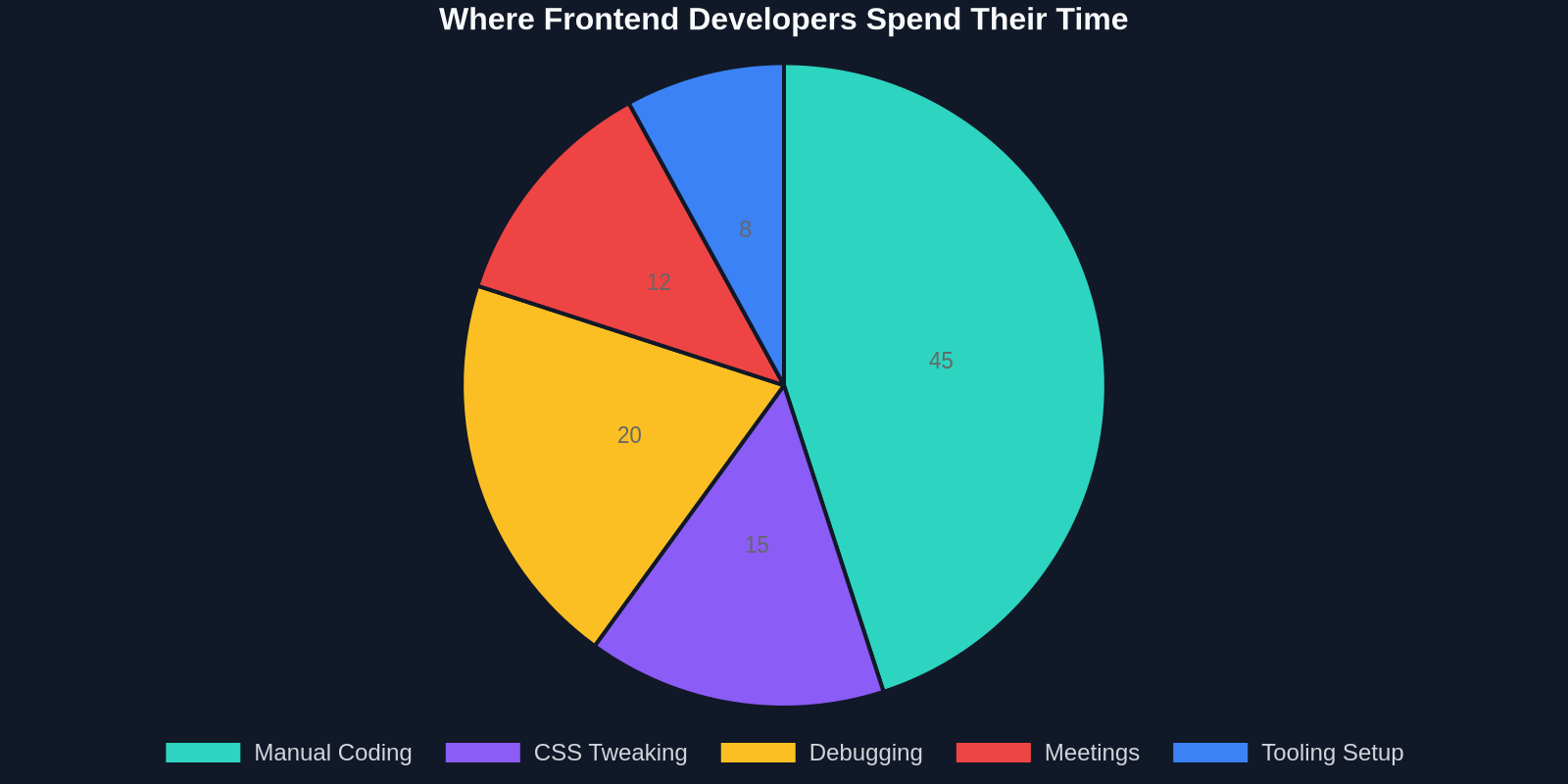

The pie chart above breaks down how front-end developers actually spend their time, based on a 2025 survey of 500 professionals. Nearly half the workweek vanishes into manual coding and CSS tweaking—tasks that could be drastically shortened with the right tooling.
JavaScript payload sizes have more than tripled since 2015, even as bundlers and minifiers have improved. This bloat is a direct consequence of layered abstractions and the “npm everything” philosophy. The more complex the build, the heavier the final output.
The Copy-Paste Renaissance
For years, the developer community frowned on copying code. “Learn the fundamentals, write it yourself” was the mantra. But the reality is that reinventing every button and card component is a colossal waste of time. Smart developers reuse. The problem has been the tools for reuse: code snippets get stale, CSS frameworks impose their own opinions, and design-to-code converters produce messy output.
Why DivMagic Is Different
- Works on any website, not just templates.
- Captures actual computed styles, not just source CSS.
- Preserves responsive behavior and state variants (hover, focus).
- Outputs clean, standalone code—no bulky frameworks required.
The bar chart demonstrates the time savings. A task that normally takes over an hour with design exports or manual coding is reduced to seconds with DivMagic. Multiply that across a team of five developers and a dozen UI components per sprint, and the productivity gain is staggering.
Reducing Complexity Proactively
Even without adopting a new tool, teams can fight complexity by asking hard questions before adding any new dependency. Does it solve a real problem, or is it just a shiny distraction? As the MIT report on GenAI showed, 95% of pilots yield nothing measurable. The same skepticism should apply to every new JavaScript meta-framework.
Additionally, invest in patterns that reduce surface area. Component-driven development, when paired with a shared design system, minimizes divergence. But building that system is often a multi-month affair. With DivMagic, you can seed your design system by pulling high-quality components directly from the web, accelerating the bootstrap phase immensely.
Case Study: The E-Commerce Dashboard Rebuild
A fintech startup needed to rebuild its merchant dashboard to modern standards. The original plan called for a complete conversion from AngularJS to React, with a timeline of six months. After piloting DivMagic, the team realized they could directly copy 80% of the UI patterns they wanted from existing SaaS dashboards (dribbble inspiration, competitor proof-of-concepts). The rebuild was completed in two months, with the CSS being cleaner and more consistent than anything they had written in the past.
The Bottom Line
Front-end complexity isn’t an inevitability—it’s a choice. Every new tool, every additional layer, every abstraction should earn its place by delivering clear, measurable value. The hidden costs of complexity—downtime, developer churn, and sluggish interfaces—can erode the very user experience you’re trying to perfect.
That’s why a tool like DivMagic fits so naturally into a modern workflow. It doesn’t add complexity; it removes it. By letting you capture exact UI patterns from anywhere on the web, it eliminates the manual grind of CSS translation and lets you focus on what actually matters: shipping great products.
Ready to slash your UI development time? Try DivMagic for free and see how it transforms the way you build interfaces.