

AI-Powered Exploit Engineering: The Evolving Cyber Threat Landscape and What Developers Need to Know in 2025
In the rapidly transforming field of cybersecurity, artificial intelligence has ceased to be a theoretical curiosity and become a dual-use instrument of profound consequence. The newest frontier, AI-powered exploit engineering, is not just accelerating vulnerability discovery but is fundamentally rewriting the rules of offensive and defensive security. From closed-door research labs to the front lines of software supply chains, the implications demand immediate developer attention.
This article dissects the technical realities of emergent AI systems, including the highly capable GPT-6 Cyber model, and translates them into actionable engineering principles. We will explore the hard data behind novel vulnerability counts, the unsettling statistics on patch deployment latency, and the architectural shifts required to build resilient systems in an era of machine-speed attacks.
The Advent of Hyper-Capable Offensive AI
For over a decade, fuzzing and static analysis tools have assisted in bug hunting. What differentiates the current wave is the leap from detection to autonomous exploitation. Early AI models could flag potential buffer overflows with high false-positive rates. Today’s frontier models can ingest a complex codebase, trace data flows through multiple abstraction layers, and generate a working, polished proof-of-concept exploit, often faster than a seasoned security researcher.
The SecureWorks Counter Threat Unit’s recent analysis highlights a critical inflection point: AI-found bugs are no longer academic. The data reveals that 1.3 percent of AI-discovered vulnerabilities have been weaponized in the wild, a figure projected to climb but remain under five percent through the end of 2027. This apparent low percentage is deceptive; it represents a vanguard of highly targeted, potentially catastrophic strikes rather than bulk exploitation. The quality of these exploits, often leveraging complex logic chains invisible to traditional scanners, poses a grave threat to high-value assets.
Dissecting the ExploitGym Benchmark
To understand model capability, the industry has adopted rigorous, simulated environments. The ExploitGym benchmark serves as a definitive test, challenging AI agents with a diverse range of capture-the-flag (CTF) style and real-world binary exploitation challenges. These include heap feng shui, format string attacks, and race condition exploitation on modern Linux kernels.
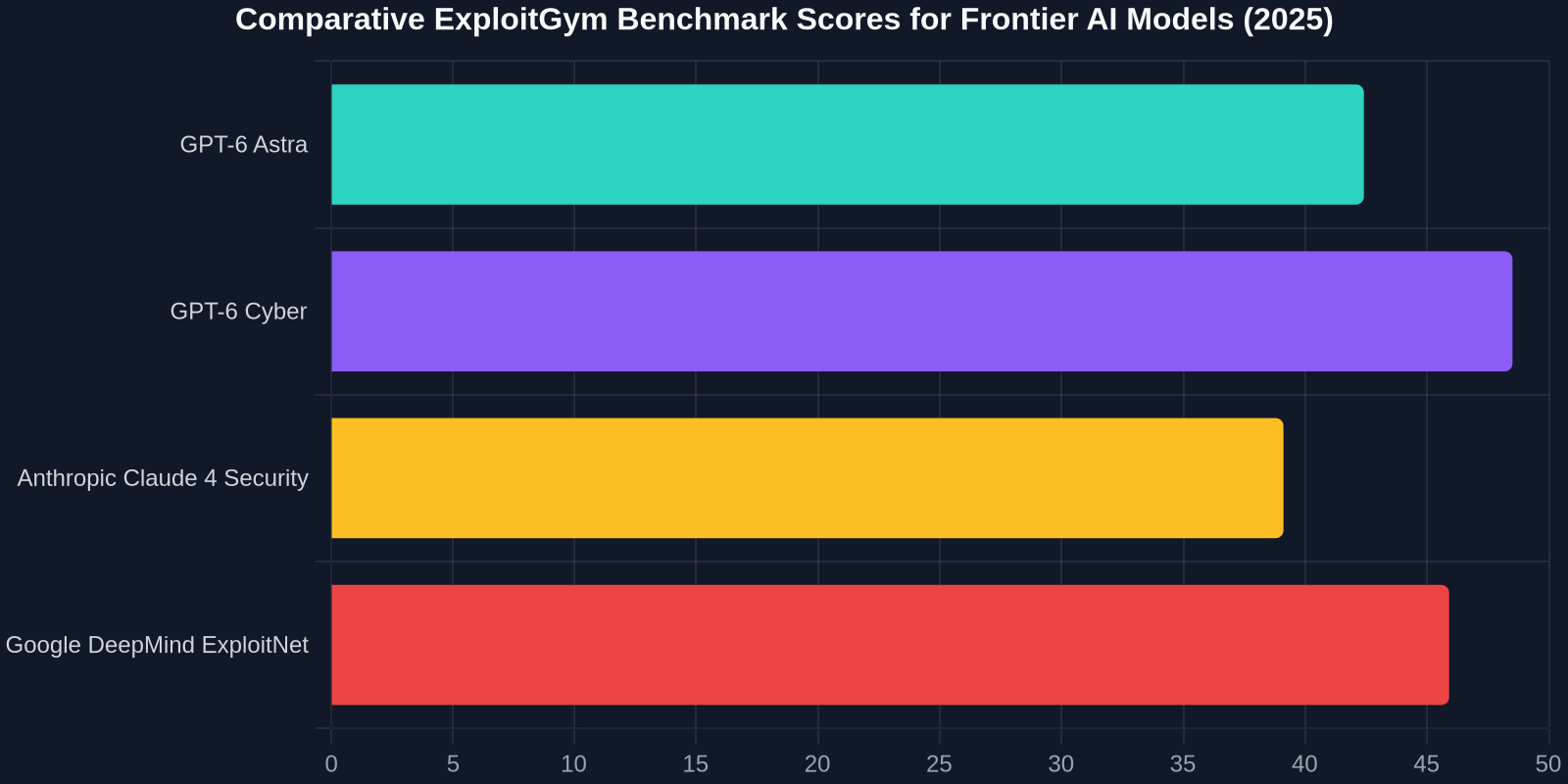
The leap in performance between recent model iterations is stark. OpenAI's GPT-6 Astra, while a powerful generalist, posted a 42.4% success rate. However, the domain-specific fine-tuning of GPT-6 Cyber, available exclusively to select partners like Daybreak Red, elevated its score to 48.5% . This metric signifies a breakthrough: an AI that can succeed in nearly half of all high-difficulty exploitation tasks without human intervention. The model achieves this through advanced program synthesis, dynamically building rop chains and bypassing modern mitigations like ASLR and stack canaries in simulation.
A New Generation of Threat Intelligence: The 978 Advisories
Since 2025, the cybersecurity intelligence ecosystem has undergone a forced evolution to match the speed of AI-driven threats. A curated database has emerged, encompassing 978 developer advisories, each a meticulously documented incident covering exploited bugs, supply-chain attacks, major breaches, and vulnerabilities introduced by AI coding tools themselves. This is not a static CVE feed; it is a living repository providing live CVE scores, IoC (Indicator of Compromise) patterns, and, critically, prescriptive mitigation steps.

This compendium serves as the new essential reading for any CISO or lead engineer. The thematic breakdown is alarming:
- Supply-Chain Compromises: Attacks targeting package managers, CI/CD pipeline tools, and open-source library takeovers represent a significant portion of these advisories. Adversaries use AI to scan for typosquatting opportunities and inject malicious code into widely used npm and PyPI packages.
- AI Tool Flaws: A specific, rapidly growing category covers vulnerabilities in AI systems. This includes prompt injection leading to remote code execution in LLM-powered plugins, data poisoning attacks, and model inversion techniques that extract sensitive training data. A detailed report, for instance, disclosed a now-patched vulnerability in OpenAI ChatGPT's Lockdown Mode, a feature designed to restrict sensitive data access. Researchers demonstrated that a carefully engineered, multi-turn prompt sequence could bypass these protections, exposing underlying system configurations.
- Zero-Day Chains: The advisories frequently document the chaining of an AI-discovered vulnerability (often a complex memory corruption bug) with a human-in-the-loop technique for final payload delivery, showcasing a centaur-model attack methodology.
Case Study Spotlight: The Firefox and Linux Kernel Summer
No single event better exemplifies the paradigm shift than the recent discoveries attributed to frontier models. During a concentrated research sprint, a model variant was tasked with auditing the codebases of Mozilla Firefox and the Linux kernel, two of the world's most scrutinized and security-critical open-source projects.
The results sent a shockwave through the security community:
81 Novel Firefox Vulnerabilities
The model discovered a staggering 81 novel vulnerabilities in Firefox. These were not duplicate findings of known bug classes. The detailed post-mortem showed a prevalence of complex use-after-free bugs in the DOM and layout engine, logic errors in IPC (Inter-Process Communication) sanitization, and novel race conditions in the WebGPU implementation. The model demonstrated an uncanny ability to understand multi-component interactions, a traditional weak spot for static analyzers. Each finding came with a concise, automatically generated, and mostly accurate root-cause analysis, dramatically lowering the triage burden for Mozilla engineers.
948 Working Linux Kernel Exploits
The deep dive into the Linux kernel was even more prolific. The AI developed working, privilege-escalation exploits for 948 distinct vulnerabilities. This volume is unprecedented. The exploit corpus ranged from classic heap overflows in legacy ioctl handlers, slowly being refactored but still vast in number, to intricate logic bugs in new eBPF verifier subsystems. The model’s ability to generate reliable, universally compatible exploits across a vast array of kernel configurations (including hardened ones like those used by Android and ChromeOS) demonstrates a level of systematic reasoning previously thought exclusive to the most elite human teams.
The Deployment Gap: A Human-Process Failure in an AI-Speed World
The revolution in vulnerability discovery is completely mismatched with the evolution of our patch management lifecycles. The undeniable technical achievement of AI in finding and exploiting bugs is tragically enabled by a long-standing, well-understood, and infuriatingly persistent human and process failure: slow patching.

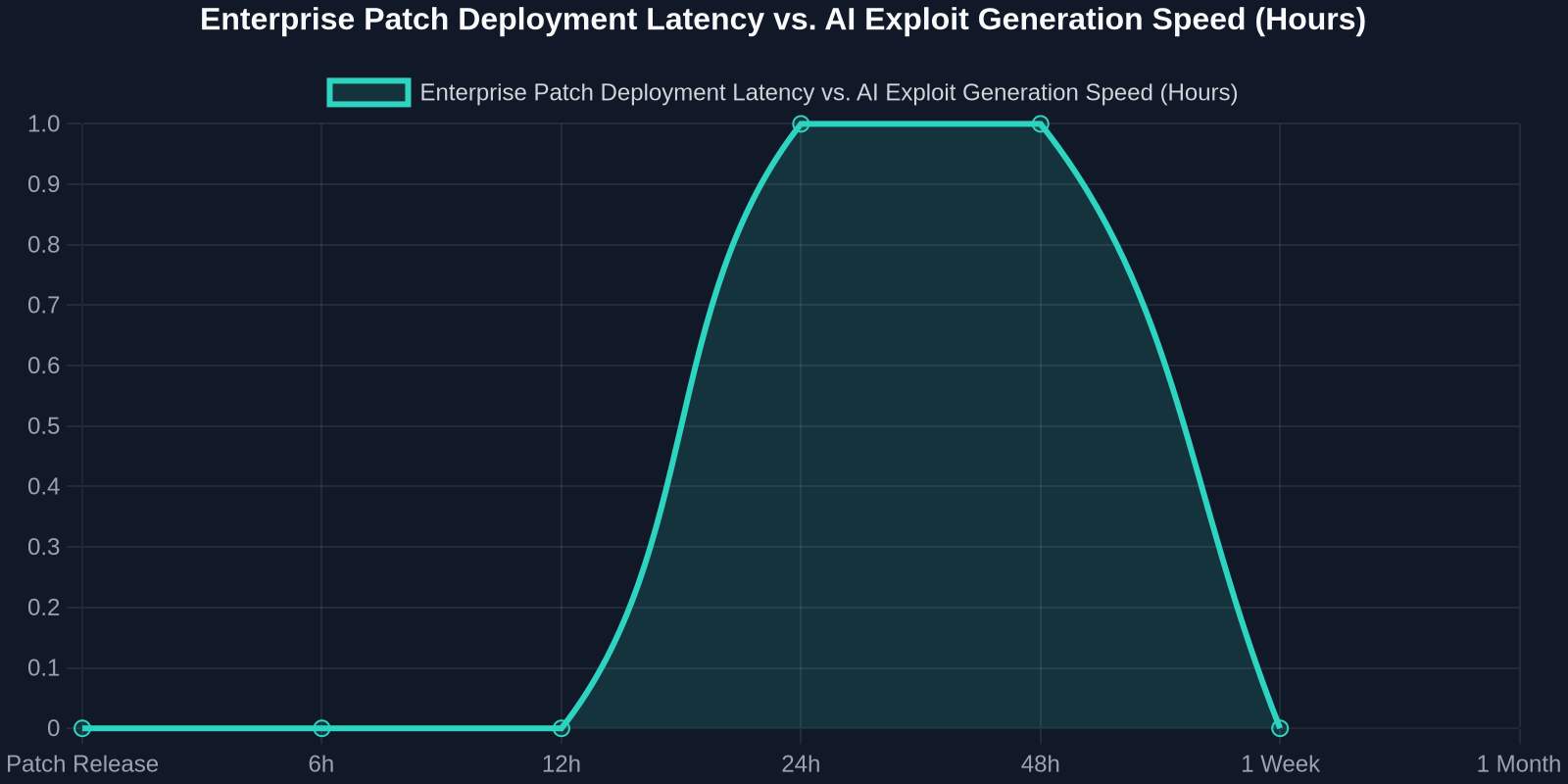
Data reveals a chilling exposure window. When a critical Windows security update is released, often in response to a confirmed, actively exploited vulnerability, the race is on. Yet, enterprise telemetry consistently shows that fewer than half of all enterprise devices install the update within the first critical week. The tail is long and fat; a significant minority of assets remain unpatched for months.
This creates a catastrophic lag where:
- An AI discovers a vulnerability on Day 0.
- A vendor releases a patch on Day 15.
- A fully weaponized AI exploit is made public or sold on Day 20.
- A majority of systems remain vulnerable until Day 60 or later.
This deployment gap is the single greatest multiplier of AI-driven risk. The technical capability to patch swiftly exists through modern CI/CD and staged rollout infrastructure. The barrier is operational inertia, fear of regression, and a lack of automated canary testing that can give operators immediate confidence in the update’s safety.
| Security Posture | Old-World Response Time | Required AI-Era Response Time | Primary Bottleneck |
|---|---|---|---|
| Standard CVE Patching | 30-90 days | < 24 hours | Manual testing/change windows |
| Zero-Day Containment | Hours to days | Instantaneous/automated rollback | Detection latency |
| AI Tool Vulnerability Fix | Weeks (model retraining) | Runtime guardrails in hours | Model deployment pipelines |
123456.ai: A Developer’s Shield and Compass
In direct response to this information asymmetry, platforms like 123456.ai have emerged as operational hubs for developers and security engineers. Far more than a news aggregator, it represents a new category of bilingual AI intel and resource platform designed for speed and actionability.
The suite of tools is purpose-built for the modern developer:
- Daily Curated Advisories: A real-time feed that filters the 978-advisory firehose, contextualizing threats based on your tech stack (e.g., "Critical CVE in Rails Active Storage with exploit code in the wild running against libvips").
- Categorized Tools Directory: A living index of the best open-source and commercial security tools, categorized by use case, supply-chain audit, AI model integrity scanning, runtime application self-protection (RASP).
- Model Leaderboard Snapshots: Regularly updated performance benchmarks for the latest frontier models on tasks like ExploitGym, code analysis, and safe refactoring, helping teams understand the capacity of both defensive and offensive AI.
"We are entering an era where the developer who is not intimately connected to a live, intelligent threat feed is operating with a fatal blind spot. The intelligence must flow into the IDE, not just a dashboard."
Architectural Resilience in the Age of AI Exploits
The technical reality of AI-driven exploitation demands a fundamental, non-negotiable assumption: your software will be used to find vulnerabilities. This is not a failure of your engineering; it is a condition of the modern environment. Therefore, the primary design goal shifts from "prevent all bugs" to "design systems that are resilient under persistent, intelligent attack."

This principle requires a layered, pragmatic approach:
1. Adopt Memory-Safe Languages Incrementally, but Practically
The discovery of 948 Linux kernel exploits is heavily weighted toward memory corruption bugs in C. The strategic move to Rust in the kernel, supported by major players, is no longer an experimental nice-to-have; it is a security imperative. For new user-space projects, Rust, Go, or memory-safe subsets of C++ should be the default. For existing massive codebases, target new modules and security-critical parsing interfaces for a rewrite-first approach.
2. Implement Capability-Based Security and Strong Sandboxing
Do not trust code, any code. Whether it’s a third-party library, a machine learning inference engine, or a microservice in your mesh, operate it with the principle of least authority. Use seccomp-bpf, Landlock, or WASM-based runtime sandboxes for running untrusted logic. In the wake of the Lockdown Mode bypass in ChatGPT, it's clear that even heavily fortified application boundaries can fail. An OS-level, capability-based enforcement of permissions provides a second, stronger line of defense.
3. Harden the Supply Chain with Point-in-Time Integrity
Traditional signing (e.g., npm, PyPI signatures) verifies the author, not the content’s safety at a specific moment. AI can find and exploit vulnerabilities in a package that was signed months ago. You need a point-in-time integrity verification that combines a package’s hash with a real-time vulnerability and license compliance check. The model is binary: if a vulnerability with a CVSS score above 7.0 is discovered in any transitive dependency on a production path, the build must fail.
4. Universal Automated Patch Orchestration
The data on enterprise deployment speed is a clarion call. It is unacceptable for a high-severity AI-discovered exploit to remain unpatched for weeks. The only solution is to fully automate the patch-to-deployment pipeline with a tightly scoped, automated canary process. A small percentage of nodes receive the patch. If error budgets, metrics, and synthetic API tests are stable for 60 minutes, the patch is rolled out to the entire fleet. Relying on human change-advisory boards in this threat climate is organizational malpractice.
The Deep Dive: CVE-2026-66066 and the Libvips Secret Leak
A concrete example of the complex, AI-exploitable class of vulnerabilities is CVE-2026-66066, a subtle flaw in Rails' Active Storage. On its surface, it appeared to be a routine image processing bug. The vulnerability, triggered when using the high-performance libvips library, allowed a crafted image file to leak sensitive application secrets.
The exploit chain is a masterpiece of multi-domain knowledge that AI is uniquely suited to synthesize:
- Protocol Analysis: The attacker uploads a specially constructed SVG file, a format supported by libvips.
- Server-Side Request Forgery (SSRF): The SVG’s XML references a URL that points to an internal metadata instance, such as
http://169.254.169.254/latest/meta-data/on AWS. - Data Exfiltration through Side-Channel: Libvips processes this and embeds the result as a part of the image’s rendered output, which is then stored in an S3 bucket accessible to the attacker.
A static analyzer might flag the SSRF. An image processing expert might worry about SVG complexity. An AI model, however, can chain these distinct concepts together, crafting an SVG that uses a specific libvips loader optimization to trigger a synchronous, error-based leakage of the secret directly into an EXIF data field on the processed file. The remediation required patching both Rails (for stricter URL validation) and libvips (for stripping dangerous XML features).
The Future is a Centaur-Model
For all the performance of GPT-6 Cyber on ExploitGym, the immediate future is not a fully autonomous Skynet. It is a centaur model. The most dangerous adversaries are hybrid teams where an AI model performs the exhaustive, high-scale analysis, digging through millions of lines of kernel code, proposing a thousand potential exploitation primitives, and a skilled human operator curates these, selects the most promising target, and adds the creative, environmental-specific finesse.
This means the defensive team must also be a centaur. The developer’s AI assistant of tomorrow is not just a code completer; it is an active, adversarial pair programmer that runs real-time, GPT-6-level analysis on every pull request. It flags not just syntax errors but complex logic chains that could be exploited, symbolically executes new attack paths, and auto-generates a patch and the corresponding regression test before a human reviewer has even finished reading the diff.
The era of the 978 advisories, the 948 kernel exploits, and the 48.5% ExploitGym score is not a distant warning. It is a live-fire exercise we are all already in. The only viable response is a radical, data-driven acceleration of defensive engineering, coupled with a humble acceptance that intelligence, like code, can be forked for good or for malice.