

The Great Style Exodus: How GitHub's 3-Year Migration from CSS-in-JS Delivered a 55% Performance Boost
For years, the web development community has been embroiled in a passionate, often dogmatic debate over the best way to style components. On one side, the proponents of CSS-in-JS championed co-location, dynamic styling, and the elimination of dead code. On the other, purists advocated for the raw speed and caching fundamentals of static CSS. While many teams argued in team meetings, GitHub engineered a verdict. Their massive, three-year migration away from a CSS-in-JS architecture within the Primer design system wasn't just a refactor, it was a performance revelation that shaved critical milliseconds off the experience of millions of developers worldwide. The final stat is staggering: a 55% reduction in server-side rendering (SSR) time and a dramatically faster component initialization lifecycle. Let’s unpack how they did it, why it matters, and what the future holds for UI architecture.
We often think about performance in terms of kilobytes and payloads, but CPU time on the server is a hidden, expensive currency. GitHub’s migration is a masterclass in identifying the true cost of developer ergonomics and deciding to pay a higher upfront engineering cost for a superior runtime outcome.
The Tipping Point: Why “Colocation” Became a Performance Anchor
To understand the migration, we must first trace the problem back to its roots. GitHub’s Primer design system, like many modern component libraries, adopted CSS-in-JS during the React boom. Libraries like styled-components or emotion allowed developers to define styles directly inside their JavaScript component files. The promise was intoxicating: seamless dynamic theming, automatic vendor prefixing, and the ability to reason about the visual output without switching context to a .css file.
The core architectural trade-off of CSS-in-JS is that it shifts styling work from build time to runtime. On a static site, this is negligible, but on a massive SSR application like GitHub.com, it becomes a critical bottleneck.
On every server request, GitHub’s servers weren't just rendering React components to HTML strings; they were also parsing and serializing style objects, hashing class names, and injecting critical CSS into the head of the document. As the application grew, the aggregate cost of this JavaScript-driven style resolution began to dominate the time-to-first-byte (TTFB). The ergonomic benefit was being paid for by the end-user’s perceived latency.
The Speed Metric: A 55% SSR Reduction
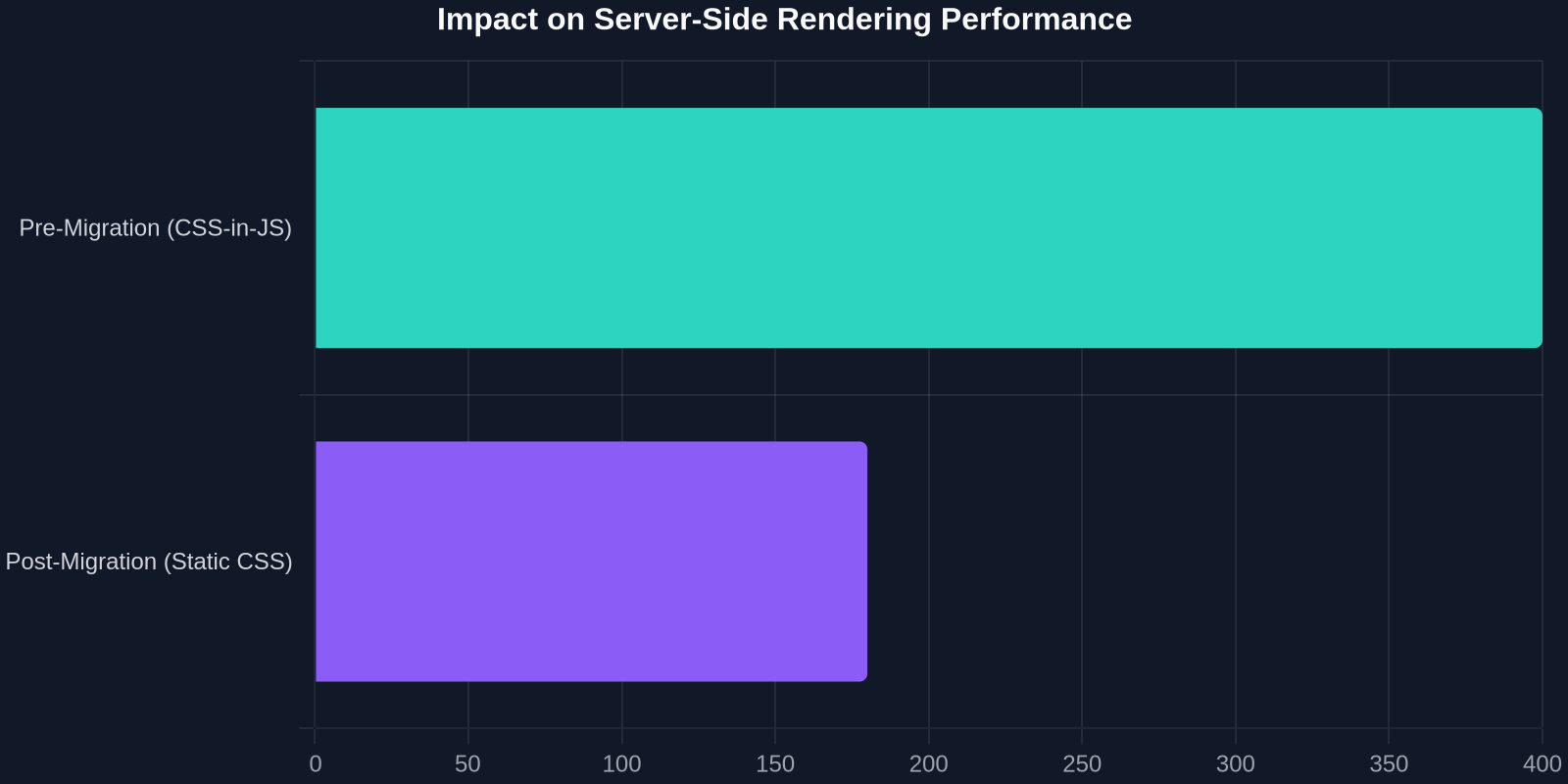
When GitHub began benchmarking the migration, the numbers immediately justified the effort. The server-side rendering pipeline is a complex dance of data fetching and component rendering. By extracting the style computation out of the JavaScript thread and back into the browser's natural CSS parsing engine, they achieved a monumental performance win.
This isn't merely a cosmetic improvement in a Lighthouse score. A 55% cut in SSR work translates directly to reduced cloud computing costs and a snappier navigation experience. For an application where code repositories and pull requests are the core business, a delay of a few hundred milliseconds can drastically impact developer flow state.
Deconstructing the Migration Strategy: It's Not Just “Delete the Runtime”
Transitioning an enterprise-scale design system is not a find-and-replace operation. The Primer team executed a phased coexistence strategy, allowing legacy CSS-in-JS components to live alongside new CSS Modules for years. The technical pivot centered on adopting a CSS-first architecture where the bulk of visual logic lives in plain .module.css files, consumed exclusively via React components.

This strategic shift involved three distinct technical phases:
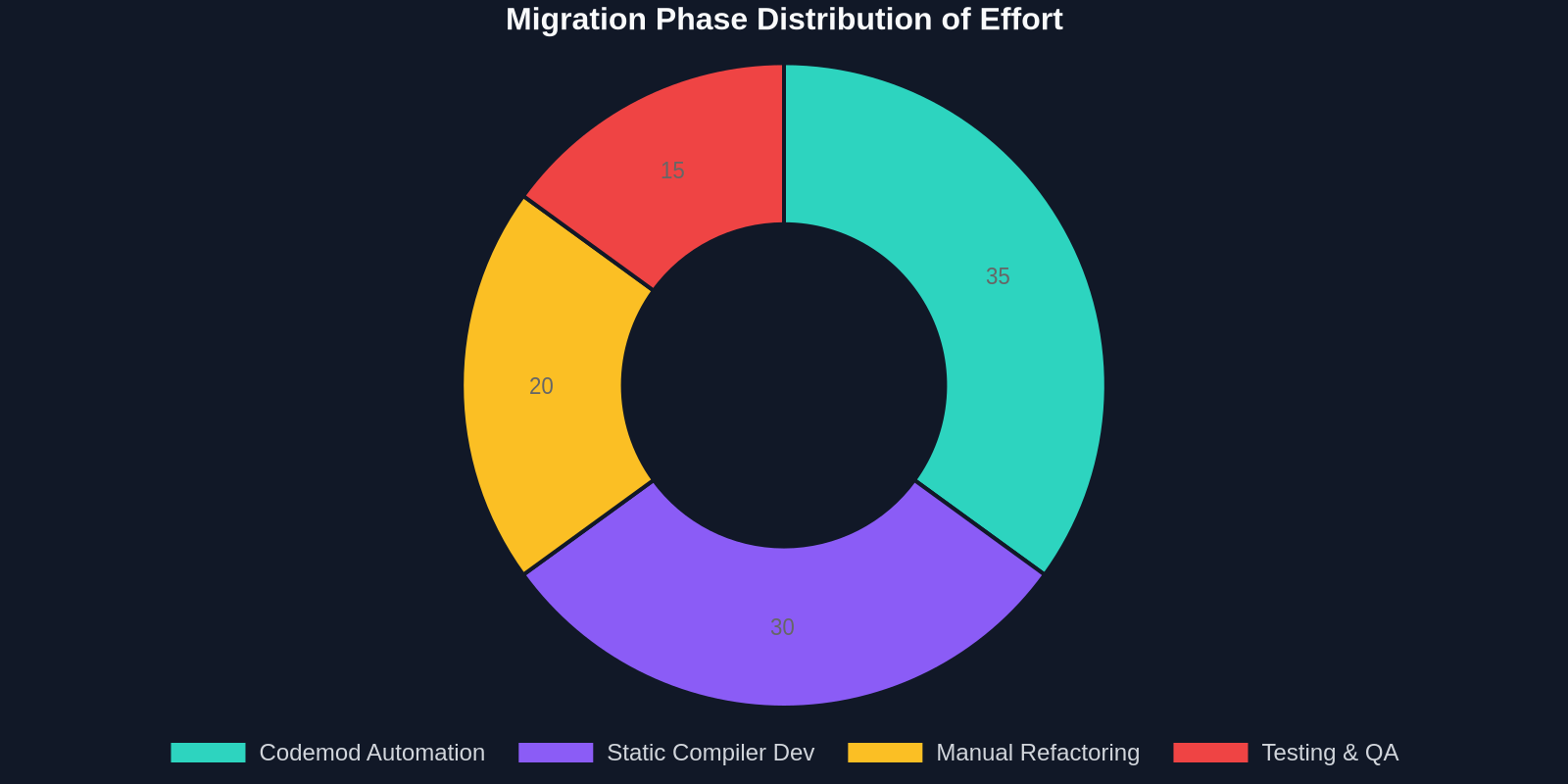
- Phase 1: Codemod Automation. The team built extensive abstract syntax tree (AST) transforms to automate the conversion of thousands of styled-component templates into CSS custom properties and flat class names, preserving design tokens.
- Phase 2: The "Static by Default" Compiler. They invested heavily in a compile-time extraction tool. This tool analyzes the dependency tree and generates atomic CSS sheets at build time, completely eliminating the runtime style injection.
- Phase 3: Runtime Feature Decoupling. Dynamic theming and contextual styles (the primary argument for JS-driven CSS) were decoupled into a slender layer of CSS custom properties (variables), manipulated via minimal DOM updates rather than massive style recalculations.
Replacing Runtime Dynamic Logic with Compile-Time Static Analysis
One of the most fascinating aspects of the migration is how they preserved the developer experience (DX) of colocated themes without the runtime cost. In CSS-in-JS, you might dynamically pass a color prop and have the library generate a unique class. In the new Primer, these cases are handled by mapping the prop to a CSS variable change on a wrapper element.
/* Bad (Runtime Generation) */
/* The JS engine calculates and injects .button-abc123 */

/* Good (Compile-time + Variables) */
.button \{
  background: var(--button-bg, #0969da);
  color: var(--button-fg, #ffffff);
\}

.button[data-variant="danger"] \{
  --button-bg: #cf222e;
\}
This pattern allows the CSS to be served as a static, cacheable asset on a CDN, while the JavaScript merely toggles attributes. The browser's highly optimized CSSOM engine handles the rest almost instantaneously.
The Hidden Costs of CSS-in-JS at Scale
To truly appreciate the migration, we have to comprehend the specific runtime overhead that was eliminated. CSS-in-JS libraries introduce a bridge between the JS heap and the CSSOM. This bridge incurs a cost for serialization, hydratation, and injection.
"Frameworks that leverage the native browser cascade will always outcompete JavaScript-driven styling, especially under the pressure of high request volumes and complex component trees."
The "bundle size" tax is particularly deceptive. Even if a CSS-in-JS runtime is "only" 12KB, that is critical-path JavaScript that must be parsed, compiled, and executed before a single pixel is visible. By nullifying this runtime, GitHub improved their time-to-interactive (TTI) metrics alongside the SSR gains.
Impact on Primer: A Design System for the World
Primer isn’t just a closed-source internal library; it's an open-source design system used by thousands of projects. The migration had to be seamless enough that external consumers could upgrade without rewriting their entire UI. The team utilized CSS custom properties as the bridge.

Component Initialization Velocity
Beyond server rendering, GitHub tracked a vital metric: component initialization time in the browser. This is the moment a component mounts to the moment it is fully interactive and styled. By removing the need for hydration-style reconciliation of server-generated class hashes with a client-side runtime, Primer components now mount roughly 2x faster than their CSS-in-JS predecessors.
This improvement is particularly visible in complex list views, like repository file trees or issue lists, where hundreds of small components mount simultaneously.
The Maintenance Paradox: More Files, Fewer Problems
A common initial complaint from developers about abandoning CSS-in-JS is the feeling of "losing" the co-location of styles and logic. There's a fear that separating Component.tsx from Component.module.css introduces cognitive friction. However, GitHub's internal surveys after the migration revealed a counter-intuitive finding.
Developers reported fewer unintended style regressions after the migration. Pure CSS offers strict scoping rules that are predictable, whereas dynamic runtime styling often leads to "specificity wars" that are hard to debug.
Because the CSS is no longer subject to the whims of JavaScript runtime order, the cascade becomes predictable. A developer can confidently modify a CSS Module file knowing the change will deterministically scope to the intended component, without leaking or requiring an !important emergency override.
Tooling and DevEx Gains
Static CSS also unlocks the full power of modern web development tools. Pre-processors like PostCSS, linters like Stylelint, and intellisense in VS Code operate much more effectively on actual .css files than on template literals inside JavaScript. The migration allowed Primer to adopt cutting-edge CSS features years earlier than most CSS-in-JS libraries could adapt to them, including native nesting and container queries.
The deterministic build step also eliminated an entire class of server/client class mismatch hydration errors. These errors, often yellow-box warnings in the console, are a classic symptom of CSS-in-JS at scale and are notoriously difficult to reproduce locally.
Economic Efficiency: Reducing the Carbon and Compute Footprint
Server-side rendering is expensive. It consumes virtual machine cycles. For a platform the size of GitHub, a 55% reduction in SSR time isn’t just a velocity metric; it’s a direct cost optimization. By shifting the workload from dynamic JS servers to static CDN edges, GitHub dramatically reduced the compute energy required to render a page.

This architectural pattern aligns with the industry's move toward "Isomorphic Static" rendering, where the server renders lightweight HTML, but the expensive part of painting the screen is offloaded entirely to pre-compiled CSS that the browser parses in native C++ code, not through a JavaScript layer.
Actionable Blueprint: Adopting Static CSS in Your Design System
For teams looking to replicate GitHub’s success, a “big bang” rewrite is almost never the answer. The meta-lesson from the Primer team is the value of a modular, incremental deprecation strategy. You can start extracting static styles immediately without forking your component library.
Step 1: Define Your Token Layer First
Before touching a single component, establish your design tokens as CSS custom properties at the :root level. This creates a hard contract between your visual language and your implementation.
Step 2: Hybrid Imports
Modern build tools like Vite, Turbopack, and webpack support importing .module.css files directly into components. Start writing new features using CSS Modules, leaving legacy components untouched.
Step 3: The Critical Path Audit
Identify the components rendered on your highest-traffic pages (login, dashboard, checkout). These are where the SSR cost is most damaging. Prioritize migrating these components to pure CSS. GitHub likely saw the most dramatic time-to-first-byte improvements from converting their header and navigation components.
Always verify the removal of the runtime import. In cases where a CSS-in-JS library is imported but not used for a specific component, the bundler still often includes the heavy runtime wrapper. A deep bundle audit is essential.
The Future: A Server-Driven Style Renaissance
GitHub's migration charted a course for the next generation of web styling. We are witnessing a pendulum swing back toward the fundamentals of the platform. Solutions like React Server Components (RSC) are further cementing the "static-first" paradigm, since RSC components output JSX that resolves to HTML, but they cannot rely on React context or hooks, they inherently push style resolution to the build layer.
The insights from the Primer team validate that zero-runtime CSS in JS (a compile-time extraction strategy used by libraries like vanilla-extract and Linaria) is the optimal compromise. It saves developers from context switching while keeping the runtime lightweight. However, GitHub’s choice of vanilla CSS Modules shows that sometimes, the simplest solution provides the most extreme performance ceiling.
Conclusion: The Verdict Is in the Render
The GitHub CSS migration is more than a technical refactor; it is a philosophical correction in frontend architecture. It reaffirms that the web platform is the framework. For years, developers solved problems by adding more JavaScript. GitHub proved that solving them by removing JavaScript yields exponential returns in speed, stability, and maintainability.
"The fastest line of code is the one you never ship to the user. GitHub just deleted an entire styling runtime from every single page load. That’s engineering optimization at its purest."
If you are maintaining a legacy CSS-in-JS system, look at your SSR budgets and waterfall charts. You might be surprised how much thread-blocking time is devoted to computing styles that could be sitting as immutable bytes on a CDN, parsed by the fastest engine in the chain: the native browser CSS parser. The era of build-time CSS supremacy is here, and GitHub has given us the industrial-scale proof.
Explore how tools like DivMagic can further accelerate your design-to-code workflow by instantly copying any existing UI element into pristine, reusable CSS, cutting down the manual translation time that often accompanies massive migrations like this one.