

Justice for CSS: Why the Web’s Most Misunderstood Language Deserves Respect
Walk into any web development conversation, and CSS will almost certainly trigger a debate. Some call it a toy language, others a necessary evil, while the rest silently battle with a misbehaving grid layout. Yet, this styling language is the quiet force behind every pixel you see online. It’s time we ask: why does CSS, the most deployed design technology in history, still fight for respect?
The Wired article “Justice for CSS” captured a sentiment many frontend developers share, CSS is often dismissed as simple or secondary to JavaScript and backend logic. But peel back the layers, and you’ll discover a declarative powerhouse that can handle everything from responsive layouts to complex animations, all while powering the web’s visual layer with unmatched performance. This post explores why CSS deserves far more credit than it typically receives and how to leverage its full potential.
The Myth of CSS as a Simple Design Language
Ask a non-frontend developer about CSS, and they’ll likely describe it as “just changing colors and fonts.” This misunderstanding undersells an entire ecosystem. The reality is that CSS has evolved into a robust, Turing-complete styling engine (yes, you can write state machines with it), capable of complex calculations and conditional logic through native properties.
The perception of simplicity stems from its low barrier to entry. Anyone can write color: red; and see results immediately. But the chasm between basic usage and mastery is vast. Modern CSS involves cascade layers, container queries, custom properties with fallbacks, scroll-driven animations, and mathematical functions like clamp() and min(). These features demand the same depth of understanding as any programming language.
Despite its perceived simplicity, CSS often baffles even seasoned engineers. A Stack Overflow survey revealed that after JavaScript, CSS is the most discussed topic, not because it’s easy, but because its quirks can be maddeningly difficult to resolve. Float clearing, z-index stacking contexts, and specificity wars have driven many to despair. Yet, these are the signs of a mature language with nuanced rules, not a trivial one.
The Evolution of CSS: From Basic Styles to Complex Layouts
The tale of CSS is one of constant reinvention. In the early 2000s, we used tables for layout and sprinkled CSS for fonts and borders. Then came floats, position tricks, and the infamous clearfix hack. Today, we have Flexbox and Grid, which have revolutionized layout design with a fraction of the code.

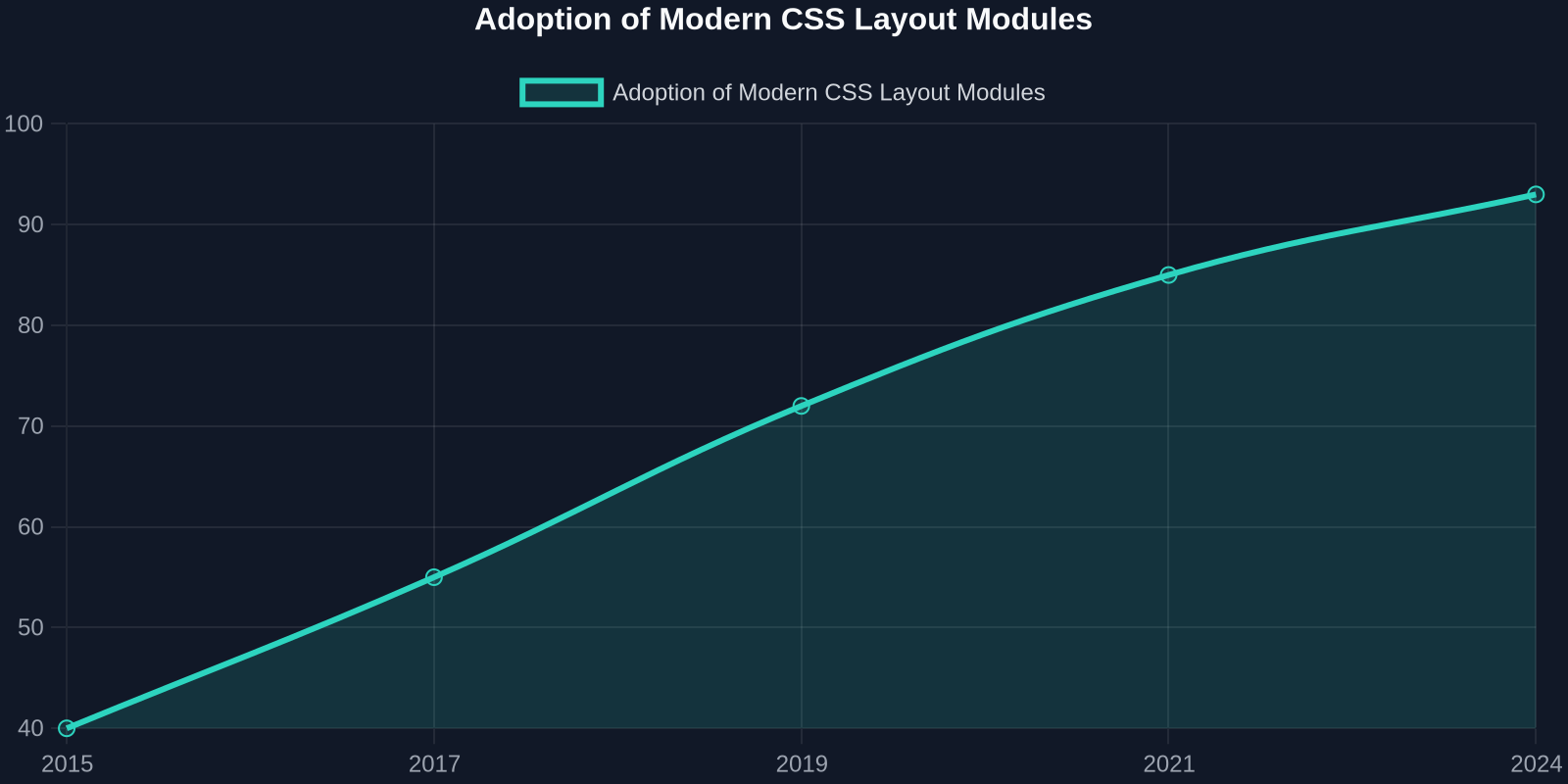
This chart shows the adoption curve for major layout tools: starting with floats (still prevalent in legacy code), then Flexbox around 2015, CSS Grid introduced in 2017 and now supported in over 95% of browsers, and the recent addition of subgrid and container queries. Each leap has expanded what’s possible without JavaScript or external libraries, making CSS a true design system language.
| Approach | Lines of Code | Responsive Effort | Maintainability |
|---|---|---|---|
| Old (Floats + Clearfix) | High | Manual breakpoints | Low – prone to breakage |
| Flexbox | Medium | Easier with flex-wrap | Good, but limited to 1D |
| CSS Grid | Low | Intrinsic with auto-fit/minmax | Excellent – declarative 2D |
| Modern (Grid + Subgrid + Container Queries) | Lowest | Fully component-responsive | Highest – reusable patterns |
Old-school CSS required developers to fight the document flow. Now, with a few lines of Grid and auto-placement, you can create magazine-worthy layouts that adapt to any viewport. This evolution alone should silence critics who claim CSS is static or limited.
Modern CSS Superpowers That Challenge Its Reputation
What exactly can modern CSS do that makes it undeniably powerful? Let’s look at features often overlooked by developers who consider CSS “not a real language.”
Logical Properties and Computed Values
CSS now understands writing modes and direction natively. Using margin-inline-start instead of margin-left makes your styles truly internationalizable without duplication. Combined with clamp(), min(), and max(), you can define fluid typography and spacing that scales seamlessly between design limits, all without a single media query.
Container Queries
For years, responsive design relied on viewport-based media queries, forcing components to break when their container size changed. Container queries allow a card component to respond to its own parent’s width, not the entire screen. This is a paradigm shift that makes component-driven design feasible in pure CSS.
Scroll-Driven Animations and View Transitions
CSS can now create stunning, performant animations tied to the scroll position using scroll-timeline and animation-timeline. Meanwhile, the View Transitions API (with CSS capture layers) enables seamless page transitions without a heavy JavaScript framework. These features showcase CSS’s role as a runtime animation engine, no longer just a static styling tool.
Because CSS animations run on the compositor thread, they can achieve a buttery 60fps even on lower-end devices. This performance advantage is a testament to the browser’s optimized styling pipeline, a pipeline that developers can tap into purely through stylesheets.
Why CSS Deserves Respect from Developers
Treating CSS as a toy leads to messy codebases, poor performance, and accessibility failures. Respect for CSS, on the other hand, yields robust, maintainable interfaces.
“CSS is not just about making things pretty; it’s the architecture of the user experience on the web. Respect it, and the web becomes a better place.”
Respecting CSS means understanding its cascade, specificity, and inheritance, not fighting against them. It means writing modular, reusable styles rather than relying on inline overrides or !important crutches. It requires learning modern layout tools and abandoning outdated techniques.
Moreover, CSS is the only language that directly shapes the user’s visual journey. A poorly styled site can frustrate users as much as a slow backend. By valuing CSS expertise, teams deliver interfaces that feel intuitive, fast, and cohesive.
CSS and Accessibility: A Matter of Justice
Accessibility isn’t just an add-on; it’s a fundamental part of web design. CSS plays a monumental role in making websites inclusive. From prefers-reduced-motion to high-contrast focus indicators, modern CSS offers tools that directly impact users with disabilities. The growing number of accessibility lawsuits underscores the legal and ethical imperative.
This statistic highlights the rising scrutiny on digital accessibility. Proper use of CSS can prevent many common pitfalls: ensuring adequate color contrast with CSS variables that adjust for themes, using :focus-visible for keyboard navigation, and building responsive layouts that don’t break under zoom or screen readers. CSS is literally at the frontline of making the web just for all users.
The Semantic Layer and CSS Synergy
CSS can enhance or destroy semantic HTML. By using selectors that respect the document structure, developers can convey meaning visually without sacrificing accessibility. For example, [aria-expanded="true"] in CSS can show a dropdown without any extra JavaScript class toggling, keeping state in the DOM where assistive technologies can access it.
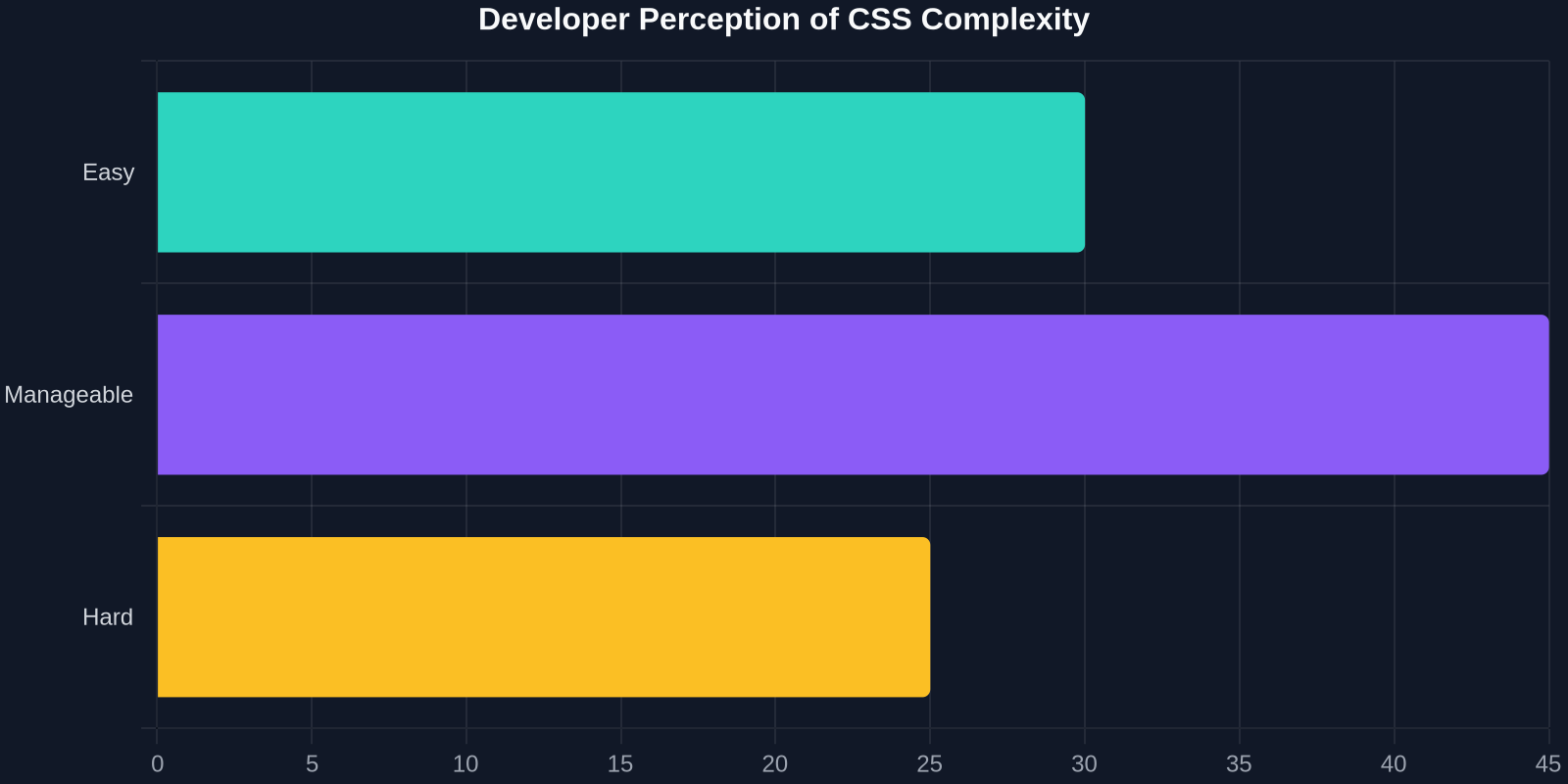
The chart reveals that while a significant portion of developers find CSS hard, a growing number view it as manageable thanks to modern features. The key is education and the right tooling.
Bridging the CSS Tooling Gap
Even with all these capabilities, CSS workflows can be tedious. Extracting perfect styles from a design mockup or an inspiring website has historically been a manual, error-prone process. This is where modern tooling finally catches up, offering ways to accelerate UI development while honoring CSS’s power.

Tools like DivMagic allow you to capture any UI element from any website and instantly convert it into clean, reusable CSS, complete with correct specificity and layout properties. Instead of spending hours poking through DevTools, you can replicate components directly and adapt them to your design system. This doesn’t diminish the need to understand CSS; it amplifies it by giving you a head start on complex styles, freeing time for creativity and optimization.
By streamlining the extraction process, developers can focus on what CSS does best: crafting pixel-perfect, responsive, and accessible interfaces. The goal is not to replace deep CSS knowledge but to respect it by integrating tooling that handles the repetitive parts, letting you dive into the architecture where it matters most.
Conclusion: A New Era of Respect for CSS
The “Justice for CSS” movement isn’t about defending a language; it’s about acknowledging its essential, sophisticated role in the web ecosystem. From pixel-pushing to performant animations and accessible designs, CSS has evolved into a language that deserves the same intellectual rigor as JavaScript or Python.
Frontend developers who embrace CSS’s full capability, its cascade, modern layout, and extensibility, will build faster, more robust, and genuinely inclusive experiences. Meanwhile, tools like DivMagic help you skip the drudgery and tap directly into CSS excellence. It’s time to give CSS the respect it has earned, one beautifully styled component at a time.