

Every front-end developer knows the feeling. npm install takes four minutes. The production bundle quietly crosses a megabyte. A one-line CSS fix requires touching three files across two packages. A new hire spends their entire first week just getting the dev server to boot.
InfoWorld's analysis of the hidden cost of front-end complexity names something most teams sense but rarely quantify: the expensive part of modern front-end work is rarely the feature code itself. It's the scaffolding wrapped around it, the build pipeline, the dependency graph, the design system, the lint rules, the CI matrix, and the tribal knowledge required to keep all of it moving.
That scaffolding has no owner, no sprint ticket, and no demo. It doesn't ship anything. It only ever subtracts, from velocity, from onboarding speed, from your ability to reason about a bug at 4pm on a Friday.
This guide breaks the cost into measurable pieces, shows you how to audit your own stack in roughly 30 minutes, and walks through reduction strategies that pay off inside a single sprint.
Complexity is a ratchet, not a slope
The first thing to internalize is that front-end complexity behaves like a ratchet. It only turns one way.
A feature ships with a new dependency. Later the feature is deprecated, but the dependency stays, removing it means checking whether anything else imports it, and nobody has that hour. A build plugin is added to fix a CSS-in-JS quirk; the underlying library is swapped six months later, the plugin remains, and it silently slows every build by 8 seconds. A one-off !important gets added to win a specificity battle that was itself created by a one-off !important two years earlier.
Each individual addition was defensible. The aggregate is a codebase where changing the button padding is a 40-minute investigation.
The four cost centers of front-end complexity
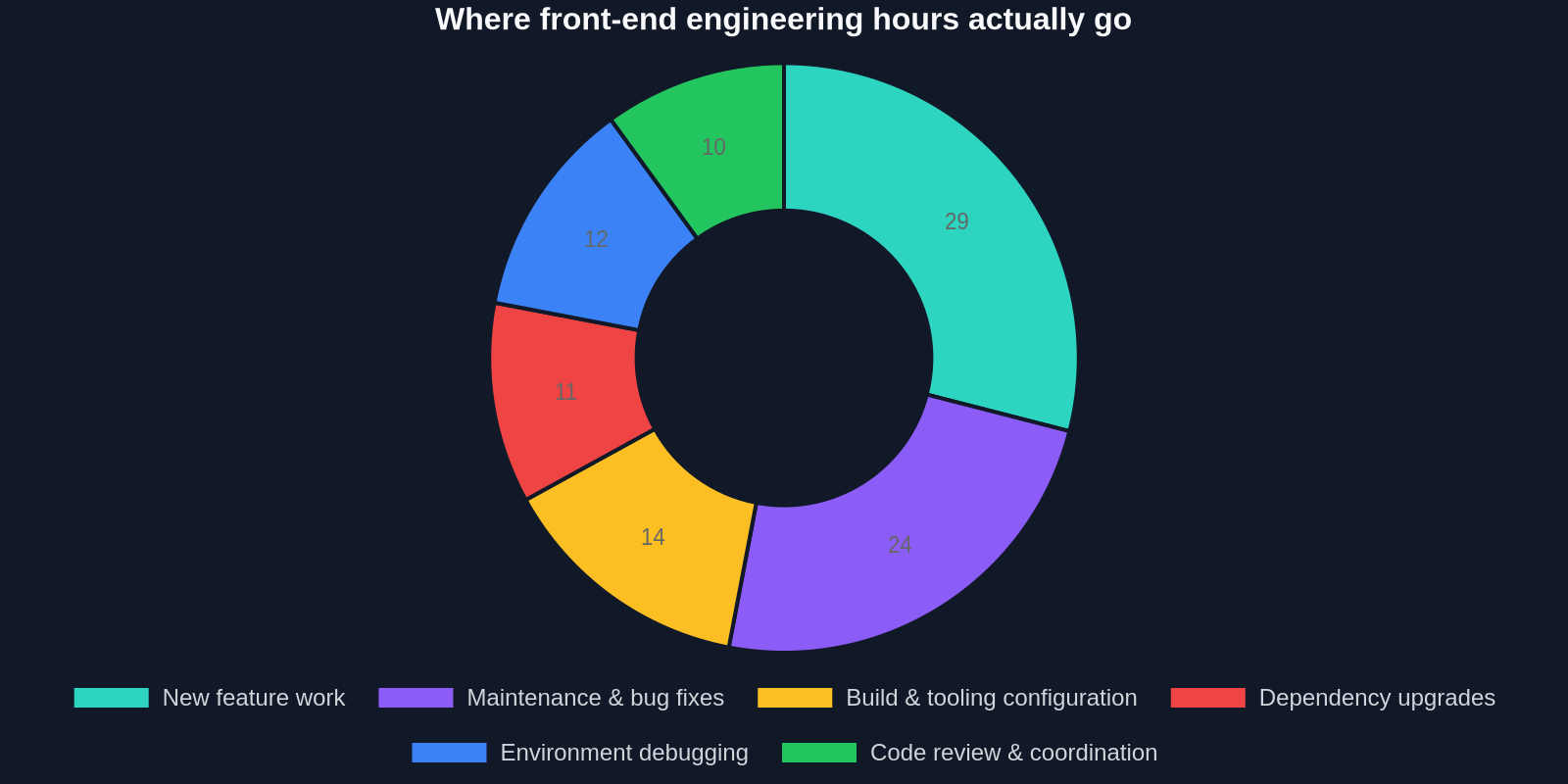
When teams try to justify a "pay down complexity" sprint, the argument usually collapses into vibes. It doesn't have to. Front-end complexity bills you in four trackable currencies.

1. Runtime and bundle cost
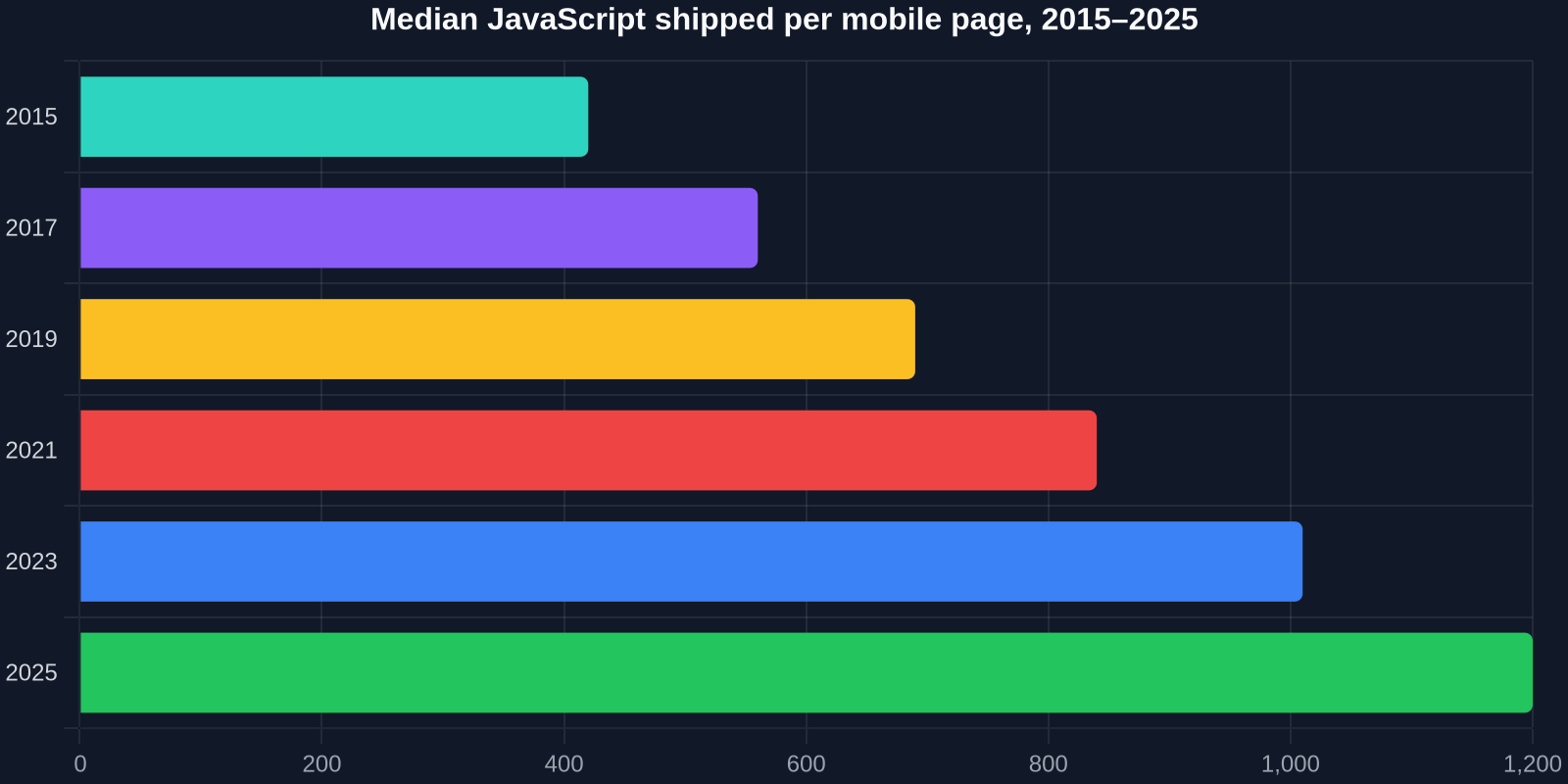
Every kilobyte of JavaScript is parsed, compiled, and executed on a device that is often a $150 Android phone on a congested network. Runtime cost is the most visible bill, because it shows up in Core Web Vitals and Lighthouse scores. It is also the smallest bill in most organizations, because users on fast laptops and good Wi-Fi don't notice it, so it never gets escalated.
2. Feedback-loop cost
This is the cost of waiting. Slow HMR, a 90-second CI build, a Playwright suite that takes 22 minutes to run on every push. If your build takes 90 seconds and a developer runs it 40 times a day, that's an hour per developer per day of pure waiting, before you count the context-switch penalty of tabbing away.
3. Coordination cost
Every abstraction boundary that doesn't match the team topology adds a meeting. Every shared component owned by nobody becomes a negotiation. Every "we can't touch the legacy app" boundary duplicates logic across two codebases that slowly diverge.
4. Cognitive and onboarding cost
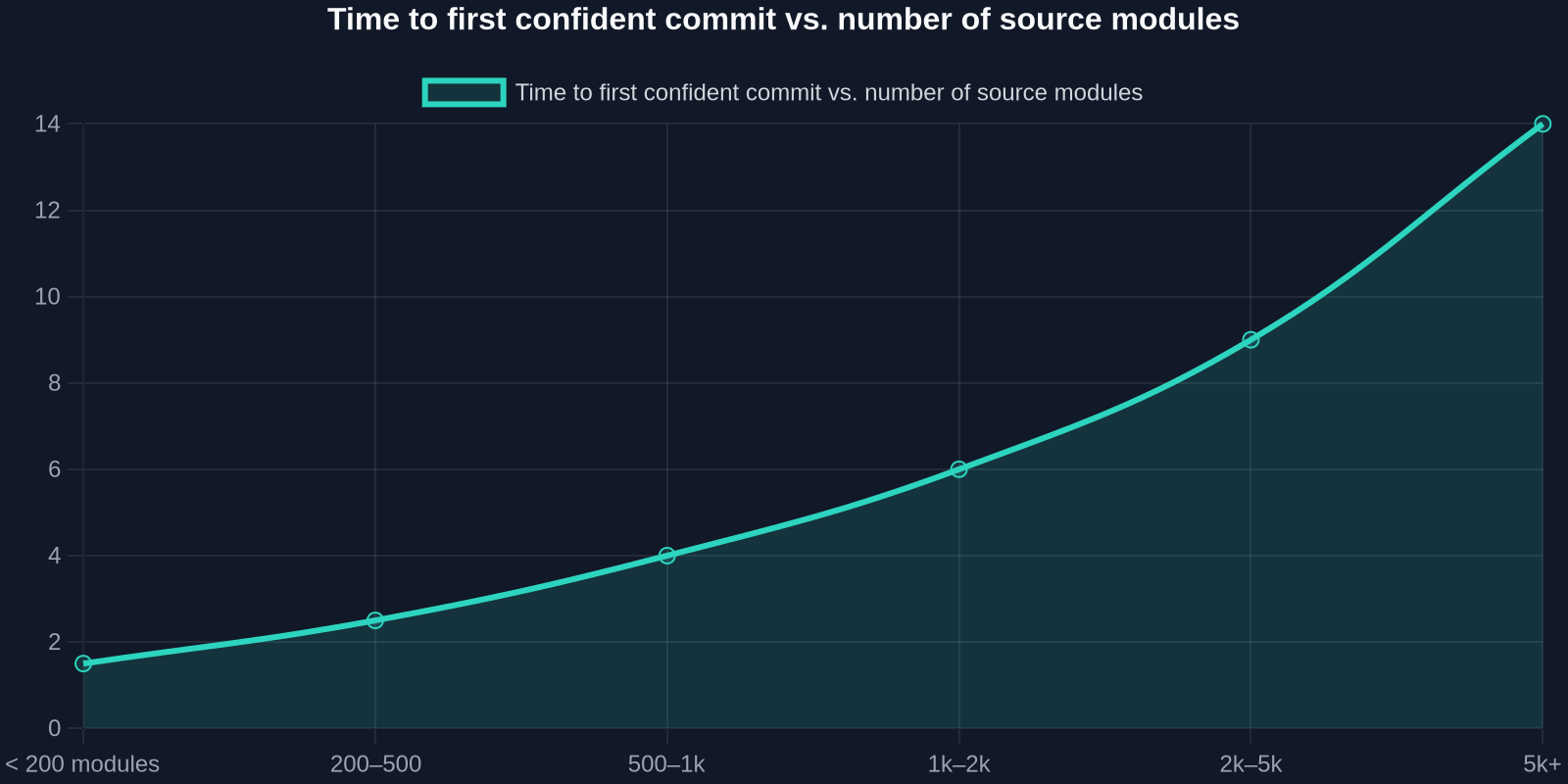
The most expensive and least measured. How long until a new developer can confidently change a component and predict the blast radius? In a well-structured codebase, days. In a codebase with four styling systems, a custom form abstraction, and a build config nobody fully understands, it can be months.
A 30-minute complexity audit you can run today
You cannot reduce what you haven't measured. Before proposing any remediation, get numbers. These commands give you a rough map of where your cost is concentrated.
# 1. How many direct dependencies do you actually declare?
npm ls --depth=0 --json | jq '.dependencies | length'

# 2. How many transitive dependencies do you actually install?
find node_modules -maxdepth 3 -name package.json | wc -l

# 3. What is the install footprint?
du -sh node_modules

# 4. What is actually shipping to users?
npx source-map-explorer 'dist/assets/*.js'

# 5. What is declared but never imported?
npx knip
The knip result is usually the most eye-opening number in the whole audit. It is not unusual for a three-year-old front-end codebase to carry 20–30% unused dependencies, dead exports, and orphaned CSS files.
Next, measure the feedback loop, because it's the cost your team feels every single day:
// scripts/measure-build.mjs
import { performance } from 'node:perf_hooks';
import { execSync } from 'node:child_process';

const runs = [];
for (let i = 0; i < 5; i++) {
  const t0 = performance.now();
  execSync('npm run build', { stdio: 'ignore' });
  runs.push(performance.now() - t0);
}
runs.sort((a, b) => a - b);
console.log(`median build: ${(runs[2] / 1000).toFixed(1)}s`);
Multiply the median build time by your team size and by an honest estimate of daily build invocations. That's your monthly feedback-loop bill, in engineer-hours. It is almost always the biggest single line item, and it is almost always fixable.
Framework churn: the upgrade treadmill nobody budgets for
Front-end has the shortest half-life of any layer in the stack. UI libraries, state managers, styling solutions, bundlers, and meta-frameworks all cycle on roughly a 24–36 month cadence. A team that upgrades eagerly spends a permanent slice of capacity on migration. A team that upgrades lazily accumulates a compounding security and compatibility deficit that eventually forces a rewrite.

Both paths are expensive. The difference is that only one of them is planned.
The practical fix is to stop treating upgrades as heroic events and start treating them as a metered pipeline:
- Pin the major version, automate the minors. Dependabot or Renovate on a weekly cadence for patch and minor versions means you never face a 40-version jump.
- Budget one migration per quarter, explicitly. Not "someday." A named objective with a date.
- Write upgrade notes during the upgrade, not after. The next engineer to touch that code is the one who pays for missing documentation.
Design system drift: the quiet multiplier
Here is the pattern that separates a five-year codebase from a clean one.
A design system ships with tokens: spacing scale, type scale, color palette. Then a product team needs a card that's almost the standard card, 12px padding instead of 16px. Rather than change the token, they override it locally. Then another team overrides the override. Within a year you have 47 distinct padding values across the app and a design system that describes a UI nobody is actually building.
That drift is expensive in a specific, compounding way: it makes every future design change a search-and-destroy mission instead of a token edit.
/* Before: three competing sources of truth */
.card   { padding: 16px; }
.panel  { padding: 1rem; }
.widget { padding: var(--space-4, 16px) !important; }

/* After: one token, one scale, one place to change */
:root { --space-4: 1rem; }
.card, .panel, .widget { padding: var(--space-4); }
Measuring the real-world baseline
One of the most underrated complexity-reduction techniques costs nothing: look at how other teams solved the same problem, and copy the smallest version of it.

When you need to rebuild a pricing table, a nav, or a hero, the mentally cheapest move is usually to spin up a new component from scratch and let it accumulate its own !important overrides. The cheaper-in-aggregate move is to inspect how a well-built site actually implemented that element, extract the computed values, and start from a known-good baseline.
// Paste in DevTools on the live site you're studying
const el = document.querySelector('.pricing-card');
const cs = getComputedStyle(el);
console.log({
  font: cs.font,
  padding: cs.padding,
  gap: cs.gap,
  radius: cs.borderRadius,
  shadow: cs.boxShadow,
  transition: cs.transition,
});
This is exactly the workflow DivMagic is built for. Instead of manually transcribing getComputedStyle output field by field, or, worse, rebuilding a layout by eye and shipping a version that's 6px off, you point the extension at any element on any live page and lift the resulting HTML and CSS directly into your project. The result is that a "new" component starts from a reference implementation rather than from an approximation, which means fewer override layers, fewer design review round-trips, and less of the drift described above.
Five reduction strategies that actually hold
Rule 1: Budget the bundle like you budget money
Add a size check to CI that fails the build when the main bundle grows more than 5% without an explicit approval. size-limit does this in about ten lines:
{
  "size-limit": [
    { "name": "main", "path": "dist/assets/main-*.js", "limit": "180 kB" },
    { "name": "vendor", "path": "dist/assets/vendor-*.js", "limit": "90 kB" }
  ]
}
A budget turns bundle growth from an invisible drift into a visible, contested decision. That's the entire point.
Rule 2: Delete one dependency for every one you add
Adopt a strict policy: any new runtime dependency requires removing an existing one or a written justification. This is not about being anti-library, it's about forcing the full lifecycle cost into the decision. A single 3 KB date library is fine. Twenty of them is 60 KB plus twenty upgrade paths plus twenty supply-chain surfaces.
Rule 3: Collapse the tooling surface
If your project has both Webpack and Vite configs, or both Babel and SWC, or both ESLint and Biome, you have two systems where one would do, and every developer now has to know which one governs. Consolidation projects are boring, unglamorous, and typically pay back in weeks.
Rule 4: Make the design system the only source of styling truth
One token file. One spacing scale. Lint rules that flag hardcoded px values in component CSS. Review discipline that asks "should this be a token?" on every override. The goal is not zero overrides, it's that every override is a deliberate, visible exception rather than the default path.
Rule 5: Instrument the feedback loop
Track median build time and CI duration as first-class metrics on a dashboard. The moment a build creeps past your threshold, typically 30 seconds locally, 5 minutes in CI, it gets treated as a bug. Feedback loop regressions are the single easiest cost to let slide, because the person who caused it barely noticed and the people who pay for it are everybody else.
| Approach | Up-front Cost | Ongoing Cost | Onboarding Drag |
|---|---|---|---|
| Add abstraction per feature | Low | High | High |
| Framework rewrite | Very high | Low | Medium |
| Incremental budget + ratchet rules | Medium | Low | Low |
| Do nothing | Zero | Compounding | Very high |
The real question isn't "how do we ship faster?" It's "how much of our codebase exists to support the features, rather than being the features?"
A 30-day complexity reduction plan
Reduction works best as a series of small, verifiable cuts rather than one heroic refactor.
Week 1, Measure. Run the audit. Produce three numbers: install size, build time, and count of unused dependencies. Put them on a dashboard. Nobody argues with a number they watched you generate from their own repo.
Week 2, Delete. Remove dead dependencies, orphaned CSS, and unused exports. Pin major versions. This is the highest ratio of value to risk in the entire plan, and it's almost always a reviewing-only change.
Week 3, Budget. Add bundle-size limits, a build-time threshold, and a dependency policy to CI. These are the guardrails that stop the ratchet from turning back.
Week 4, Consolidate. Pick the single worst duplication, two HTTP clients, two styling systems, two date libraries, and collapse it. Announce the before/after numbers to the team. Momentum is a technical asset.
Why this matters now
The front-end ecosystem is entering a period where the marginal cost of adding capability has dropped dramatically, code generation, AI-assisted scaffolding, and component generators all make it trivially easy to produce more code. That makes the marginal cost of maintaining capability the dominant variable. A team that can generate 500 components a week but cannot delete one is in a worse position than a team that writes twenty by hand.
The hidden cost of front-end complexity is not a technology problem. It's a discipline problem: the discipline to measure, the discipline to delete, and the discipline to treat guardrails as part of the product rather than an interruption of it.
Complexity is not the price of scale. It's the price of never having decided what to remove.
Frequently asked questions
How do I know if my front-end is actually too complex?
Use three signals. First, time-to-first-meaningful-commit for a new hire, measured in days. Second, the ratio of build time to the number of files changed in a typical PR. Third, whether a single developer can hold the styling system in their head, if not, drift is already happening.
Isn't some complexity unavoidable in a large application?
Yes. The goal is never zero complexity; it's rented complexity that can be returned. A well-factored abstraction is complexity you chose and can remove. A tangle of overrides and transitive dependencies is complexity that accumulated and that no one can safely delete.
What's the fastest single win?
Audit unused dependencies and dead exports. It is typically a same-day change, carries near-zero product risk, reduces install and build time immediately, and gives you a credible number to show stakeholders before you ask for bigger changes.
How does copying UI from a reference site fit into a reduction strategy?
It removes one of the biggest sources of drift: rebuilding something from visual approximation, then papering over the differences with overrides. Starting from a real, working implementation, extracted with a tool like DivMagic, means you begin at the correct spacing, type scale, and shadow values, and you have far less to maintain later.