

Frontend Trends 2025: The Evolution of UI Development
The frontend landscape is in constant motion. With every passing year, new tools, frameworks, and paradigms reshape how we build user interfaces. In 2025, the pace of change is faster than ever, driven by artificial intelligence, server-side rendering, and a renewed focus on developer experience. Whether you're a seasoned engineer or just starting out, understanding these shifts is crucial to staying relevant and productive.
In this comprehensive guide, we'll explore the most impactful frontend trends of 2025, from the real-world adoption of AI coding assistants to the rise of React Server Components and the unstoppable momentum of Tailwind CSS. We'll also look at how tools like DivMagic are helping developers accelerate their workflow by automating the tedious parts of UI development.
The Rise of AI in Frontend Development
Artificial intelligence has moved from a buzzword to a practical, everyday tool for frontend developers. GitHub Copilot, ChatGPT, and new AI-powered design-to-code converters are now part of the standard toolkit. However, the numbers reveal a more nuanced story.
While 85% of developers have experimented with or adopted AI coding assistants, only 44% have integrated them deeply into their daily workflows. This gap highlights that AI is currently excellent at boilerplate generation, unit tests, and simple refactoring, but it often struggles with complex business logic, accessibility requirements, and maintaining consistent design systems. The most productive developers use AI as a pair programmer, not a replacement.
AI coding assistants are not replacing developers; they're augmenting productivity. The real value lies in automating repetitive tasks like generating PropTypes, scaffolding forms, or writing API calls, not in making architectural decisions.
Another emerging trend is AI-driven UI generation from wireframes or even natural language descriptions. Tools like Vercel's v0 and various Figma plugins can now produce React components directly from design mockups. However, the output often requires manual refinement to match production standards. For developers who need to quickly replicate a UI they've seen on the web, DivMagic offers a more direct solution: copy any element from any website as clean HTML, Tailwind CSS, or React JSX, ready to use in your project.
TypeScript's dominance is undeniable. With 73% of frontend developers using it as their primary language, it has become the de facto standard for new projects. Type safety, better tooling support, and seamless integration with frameworks like Next.js and Nuxt have made JavaScript without types feel like a relic of the past. The trend is clear: if you're starting a new project in 2025, TypeScript is the default choice.
React Server Components and the New Full-Stack
React Server Components (RSC) have finally matured, and they are reshaping the way we think about frontend and backend boundaries. In frameworks like Next.js 14+, RSC allows components to run on the server, fetching data directly and sending only the rendered HTML to the client. This eliminates the need for client-side data fetching libraries like React Query or SWR for many use cases, and it dramatically improves performance by reducing JavaScript bundle sizes.

The shift to server-first rendering is not just a React phenomenon. Vue and Nuxt have adopted similar patterns with server components, and even SvelteKit offers server-side rendering out of the box. The era of the "single-page application" is being replaced by a hybrid model where the server handles the initial render and data fetching, while the client takes over for interactivity.
The frontend of 2025 isn't about choosing a framework, it's about choosing the right architecture for user experience, performance, and developer speed.
This architectural change means developers must now think about component boundaries in terms of server and client. A common pattern is to create a server component that fetches data and renders static UI, then pass interactive bits to client components. This separation of concerns can be challenging to get right, but the benefits in load times and SEO are substantial.
The dominance of meta-frameworks is another key trend. Over 60% of greenfield projects now begin with Next.js (React) or Nuxt (Vue) because they provide built-in routing, server-side rendering, static generation, and optimal performance out of the box. This trend is likely to continue as the demand for fast, SEO-friendly web applications grows.
The Shifting Landscape of CSS: Tailwind and Beyond
CSS has undergone a quiet revolution. For years, the debate between CSS-in-JS and traditional stylesheets raged on. But in 2025, a clear winner has emerged: utility-first CSS, led by Tailwind CSS. The reasoning is simple: it scales. Large codebases often suffer from CSS specificity wars, dead code accumulation, and inconsistent naming conventions. Tailwind solves these problems by providing a constrained set of utility classes that compose into any design.
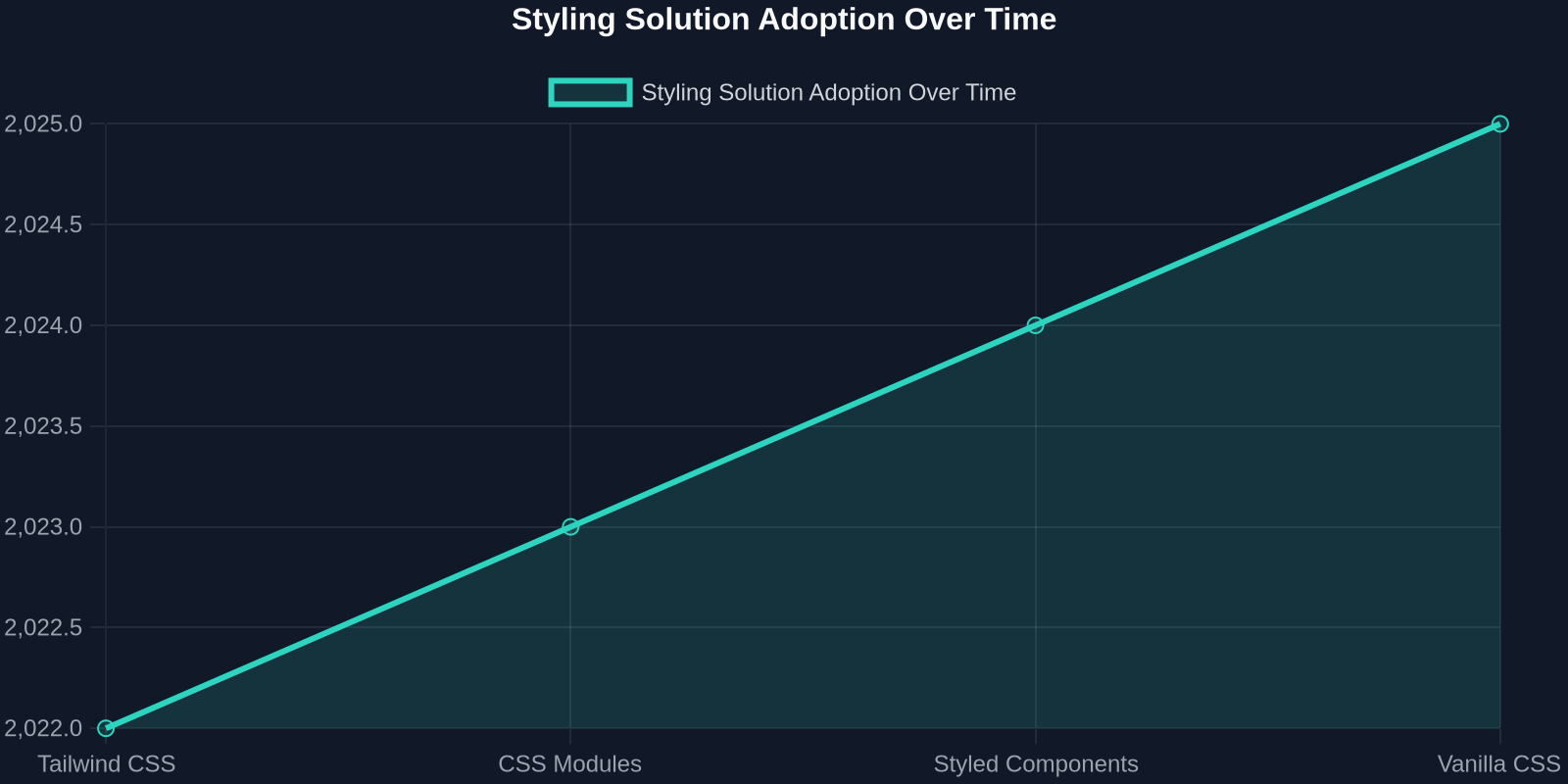
As the chart shows, Tailwind adoption has skyrocketed while CSS-in-JS libraries like Styled Components have plateaued. The main reason is performance. Zero-runtime CSS solutions like Tailwind generate a static CSS file at build time, avoiding the runtime overhead of injecting styles. This is particularly important in the age of Core Web Vitals and the need for instant page loads.
The shift to utility-first CSS is not just a trend, it's a response to the scalability issues of traditional CSS at scale. Tailwind provides a shared language for designers and developers, reducing the time spent writing and debugging styles.
However, Tailwind is not the only player. The rise of Panda CSS, StyleX, and other compile-time CSS solutions suggests that the industry is converging on build-time style generation. For developers who need to quickly replicate a design from an existing website, DivMagic can extract the exact styles, including Tailwind classes, from any element, saving hours of manual inspection and rewriting.
The table highlights why Tailwind has become the go-to: it offers the best balance of scalability and performance. While the learning curve is steeper than plain CSS, the productivity gains once you master the utility classes are enormous.
CSS debugging still consumes a surprising amount of time. According to recent surveys, developers spend up to four hours per week resolving layout problems, specificity conflicts, and responsive design bugs. This is where a tool like DivMagic becomes invaluable: instead of manually inspecting and copying styles, you can capture the exact UI you need and get clean, production-ready code in seconds.
WebAssembly Goes Mainstream
WebAssembly (Wasm) has been on the horizon for years, but in 2025 it has finally crossed the chasm into mainstream adoption. Thanks to improved tooling and broader browser support, Wasm is now powering high-performance applications that were previously only possible as native apps. Figma, Adobe Photoshop, and complex data visualization tools are prime examples.

For frontend developers, the most exciting development is the ability to run non-JavaScript code in the browser at near-native speed. This opens up possibilities for using Rust, C++, or Go to handle compute-intensive tasks like image processing, video encoding, or large dataset manipulation. The Wasm component model and the WebAssembly System Interface (WASI) are also making it possible to run server-side workloads in secure sandboxes, blurring the line between frontend and backend.
WebAssembly is bridging the gap between web and native performance, enabling complex applications like Figma and Photoshop to run in the browser. This trend will only accelerate as the ecosystem matures.
While Wasm isn't replacing JavaScript, it complements it perfectly. The future is a polyglot web where JavaScript orchestrates the UI and Wasm handles the heavy lifting.
Developer Experience: The Silent Productivity Killer
Beyond the flashy technology trends, 2025 is also the year of developer experience (DX). As applications grow more complex, the time spent on setup, configuration, and repetitive tasks can eat into productive coding time. Tools that streamline the development workflow are no longer a luxury, they are a necessity.
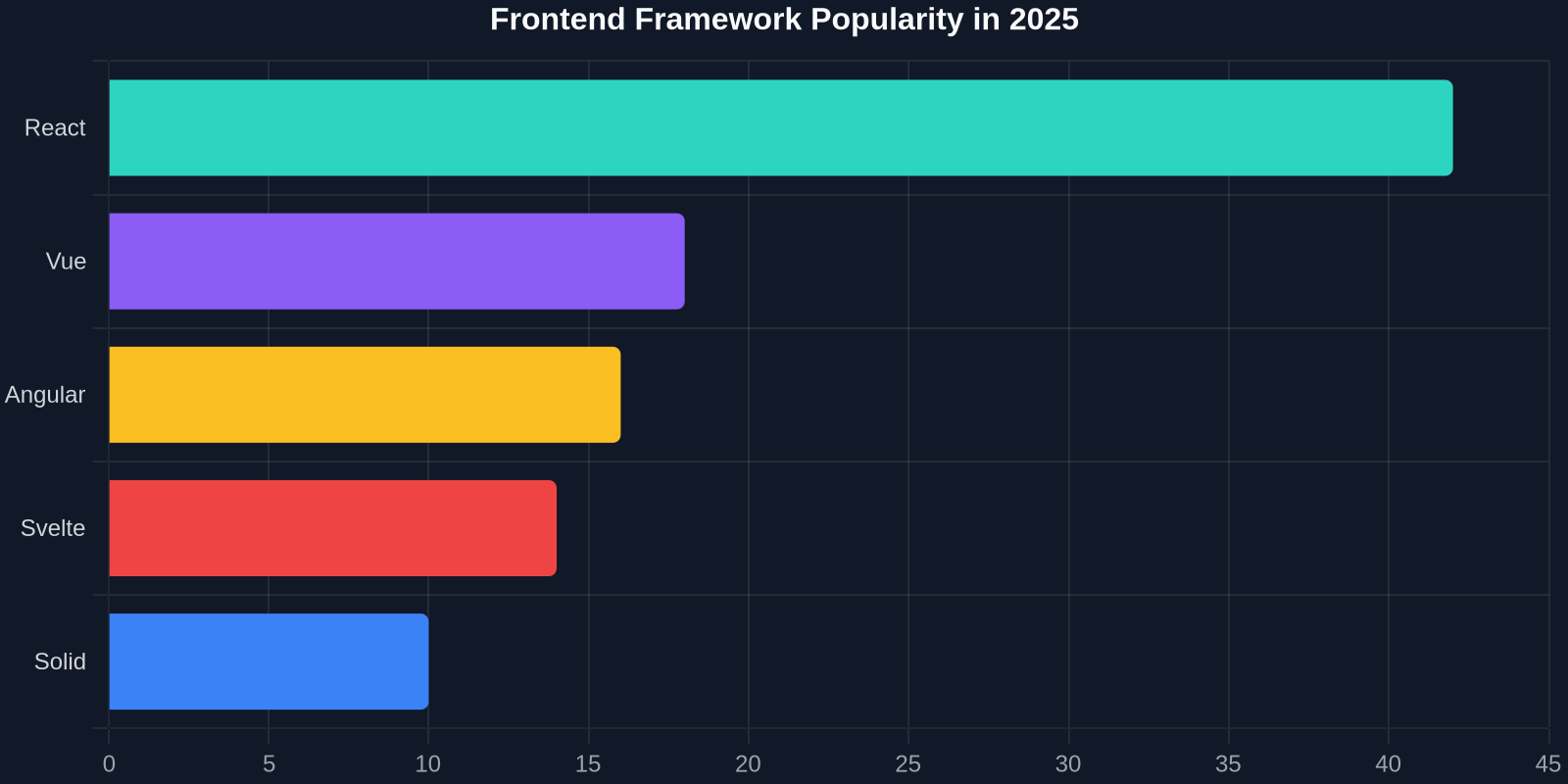
The chart above shows the current framework popularity. React remains the king, but the fragmentation of the ecosystem means developers often have to switch between different stacks. This is where the ability to copy a UI component from any website into your project becomes a superpower. DivMagic allows you to instantly capture a button, card, navbar, or any other element as clean HTML, Tailwind CSS, or React JSX, without having to rebuild it from scratch.
In a typical workflow, a developer might see a great design on a competitor's site or a reference page. Traditionally, they would need to inspect the element, understand the CSS, rewrite it to fit their project's conventions, and test it across breakpoints. With DivMagic, this process is reduced to a single click. The extension extracts the component's structure and styles, automatically converting them to your preferred framework. This not only saves time but also ensures consistency and allows you to learn from real-world implementations.
Tools like DivMagic let you copy any UI from any website, instantly converting design inspiration into clean, reusable code.
Other DX improvements include the rise of Bun as a fast JavaScript runtime, the adoption of Turbopack and Vite for instant builds, and the integration of AI-powered code review tools. The common thread is a relentless focus on reducing friction and letting developers spend more time on what matters: building great user experiences.
How DivMagic Accelerates Your Frontend Workflow
At DivMagic, we understand that frontend development is as much about speed as it is about creativity. The ability to quickly replicate and adapt UI components from existing websites gives you a massive head start. Whether you're building a design system, prototyping a new feature, or learning from the best implementations on the web, DivMagic is the tool that makes it happen.

Instead of spending hours manually extracting CSS and HTML, you can focus on the logic and interaction that make your application unique. With support for Tailwind CSS, React, and standard HTML/CSS, DivMagic fits seamlessly into any modern stack. It's the natural evolution of the "copy-paste" workflow that every developer has used at some point, now finally automated, accurate, and production-ready.
As the frontend trends of 2025 continue to evolve, one thing remains constant: the need for tools that eliminate repetitive work and amplify your capabilities. DivMagic is built for developers who want to stay ahead, by turning the web into their personal component library.
Conclusion
The frontend in 2025 is a blend of AI assistance, server-first rendering, utility CSS, and high-performance runtimes. JavaScript still rules, but TypeScript is the new standard. Frameworks like Next.js and Nuxt are the foundation of most new projects, while Tailwind has solved the CSS scalability problem for good. WebAssembly is finally delivering on its promise, and developer experience has become a critical competitive advantage.
To thrive in this environment, you need to adopt the right tools. DivMagic is one of those tools, a simple yet powerful way to capture and reuse any UI from the web, letting you build faster and learn from the best. Embrace the trends, but don't forget to equip yourself with the extensions that make your daily work more efficient.