
Microsoft's Developer Tools Leadership Transition: A New Chapter for Frontend Innovation
When Julia Liuson announced her retirement as head of Microsoft's Developer Division in April 2026, the news rippled through the global developer community. For more than a decade, she steered the ship that brought us Visual Studio Code, TypeScript, .NET Core, and GitHub Copilot, tools that fundamentally reshaped how millions of frontend developers write, debug, and ship code. Her departure marks not just a personnel change, but a symbolic pivot in the history of modern software development.
In this post, we’ll explore Liuson's legacy, the measurable impact of Microsoft’s tools under her leadership, and what the transition means for frontend engineers navigating an increasingly AI-driven landscape. Along the way, we’ll examine how new utility tools, like DivMagic, are filling the gaps in everyday frontend workflows, and why the next era of developer tools will be defined by speed, integration, and intelligent automation.
The Architect Behind the Modern Microsoft Stack
Julia Liuson joined Microsoft in 1992 and rose to become one of the most influential women in technology. As Corporate Vice President of the Developer Division, she oversaw the transformation from closed-source, Windows-centric tooling to an open, cross-platform ecosystem. Her tenure included the birth of Visual Studio Code in 2015, now the most popular code editor on the planet, and the strategic embrace of GitHub after its acquisition in 2018.
Liuson understood that developer tools are not just products, they are platforms for community growth. Under her guidance, Microsoft shifted from a “build it and they will come” mentality to active collaboration with millions of open-source contributors.
This period saw the company release .NET Core as open source in 2014, introduce the Language Server Protocol (now used by countless editors), and, perhaps most critically, launch GitHub Copilot in 2021, the first major AI pair programmer. Each of these milestones democratized access to professional-grade tooling and set a new bar for what developers expect from their daily environment.
A Culture of Continuous Delivery
One of Liuson's most underrated contributions was the cultural shift toward rapid iteration. Visual Studio Code’s monthly release cycle, TypeScript’s strict backward compatibility guarantees, and Copilot’s constantly improving models taught the industry that developer tools must evolve at the same pace as the frameworks they support. This philosophy directly influences how frontend engineers now think about their own workflows.
The Legacy in Numbers: How Microsoft Tools Reshaped Development
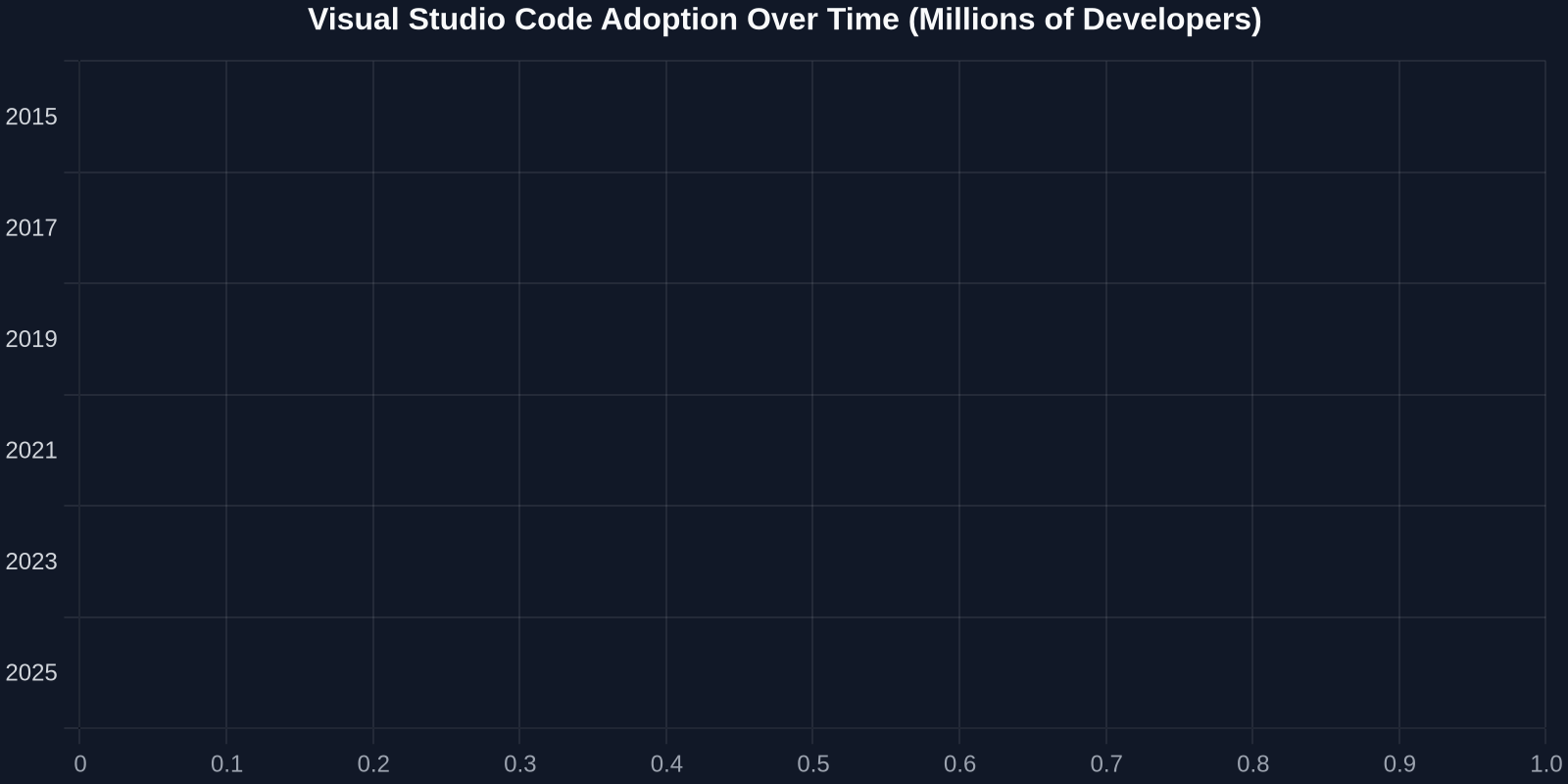
Statistics paint a clear picture of this transformation. According to the Stack Overflow Developer Survey 2025, Visual Studio Code was used by 87% of professional developers. GitHub Copilot surpassed 2.5 million daily active users in 2024, with more than 40% of code on GitHub being written with AI assistance. These numbers are not just vanity metrics, they reflect a fundamental shift toward lightweight, intelligent tooling.

Behind these figures lies a deeper story: Microsoft’s developer division generated an estimated $5.2 billion in annual revenue through Visual Studio subscriptions, GitHub Enterprise, and Azure DevOps by 2025. More importantly, they reduced the barrier to entry for millions of new developers. A student in Nairobi can now write production-grade TypeScript with the same editor and AI assistant as a senior engineer at a Fortune 500 company.
The Impact on Frontend Workflows
Frontend development, in particular, has been radically reshaped by these tools. Before the Liuson era, building a responsive, accessible UI meant juggling heavy IDEs, inconsistent browser debugging, and a lack of intelligent autocomplete for CSS and JavaScript. Today, a typical frontend workflow looks completely different.
This evolution matters because frontend developers are now expected to deliver pixel-perfect UIs faster than ever. The days of spending half a day adjusting CSS grid layouts or manually copying hero sections from a live site are dying, at least for those who adopt the latest tools.
What the Leadership Change Means for Developers
Transitions at this level always invite speculation, but the outlook is overwhelmingly positive. Microsoft has institutionalized the open-source, developer-first culture that Liuson championed. The incoming leadership, likely drawn from within the division’s deep talent pool, will inherit a thriving ecosystem and a clear mandate: intensify AI integration and push further into cloud-based development.
"Julia Liuson didn’t just ship tools; she cultivated communities. Her real legacy is the generation of developers who now build with empathy because their tools taught them how."
For frontend engineers, this means we can expect even tighter coupling between design and code, smarter component generation from natural language prompts, and deeper collaboration features in GitHub. The Copilot X roadmap already points to an agentic future where developers describe a UI element and watch it materialize in real time. This shift will reward those who invest in learning to orchestrate these tools.
Accelerating Frontend Development in the AI Era
Yet, for all the AI advancements, a stubborn chunk of frontend work remains painfully manual: recreating existing UI designs from live websites. Whether it’s to replicate a landing page section, a pricing table, or a form component, developers often find themselves inspecting elements, copying CSS rules, tweaking layout, and re-implementing responsive behavior, a process that can consume 30–45 minutes per component.
This is where purpose-built tools like DivMagic step in. DivMagic is a browser extension that lets you copy any UI from any website with a single click. It extracts the exact HTML, CSS, and layout logic and generates clean, responsive code that you can paste into your project. No more manual dissection; no more fiddling with z-index or flex properties.
Next time you need to replicate a complex UI element, try DivMagic’s one-click copy. It typically reduces the task from 35 minutes to under 2 minutes, freeing you to focus on logic and interactivity.
This kind of utility isn’t just a timesaver, it’s a strategic advantage. In a landscape where time-to-market shrinks every quarter, automating the rote parts of frontend dev keeps you competitive. And as Microsoft’s own tools evolve toward AI-generated components, utilities like DivMagic sit comfortably alongside them, filling the niche of real-world UI extraction that large language models often fumble on.
Integration with Modern Stacks
DivMagic works seamlessly with frameworks like React, Vue, and Next.js, outputting JSX or standard HTML as needed. It respects Tailwind classes, CSS modules, and even styled-components. This interoperability echoes Liuson’s philosophy: tools should meet developers where they are, not force them into a single ecosystem.
Lessons for Developer Communities
Microsoft's success under Liuson offers three clear lessons for anyone building or adopting developer tools today:
- Openness wins. The decision to open-source .NET and build VS Code as a public, extensible platform created a moat of community trust that no proprietary tool could match.
- Speed is a feature. Monthly release cycles and instant feedback loops trained developers to expect continuous improvement, and to reject stagnation.
- Automation is not a threat. Copilot proved that AI assistance boosts productivity without replacing the human creativity required for great UX.
The most successful tools of the next decade won’t just assist developers, they’ll eliminate entire categories of repetitive work. UI copying is a perfect example of a task that shouldn’t require human effort anymore.
These principles directly inform the rise of specialized productivity boosters like DivMagic. When the heavy lifting of UI extraction is automated, developers spend more time on state management, performance, and accessibility, the areas that truly differentiate an application.
The Rise of Lightweight, Specialized Tools
We’re witnessing a fragmentation of the monolithic IDE model into a constellation of focused utilities. Linters, formatters, snippet managers, and now UI extractors each do one thing exceptionally well. This modularity, inspired in part by VS Code’s extension marketplace, allows developers to craft a personalized toolkit that matches their exact workflow. DivMagic exemplifies this trend: a laser-focused extension that solves a single, persistent pain point with maximum efficiency.
Preparing for the Next Generation of Tools
Liuson’s retirement closes one chapter but opens another. The foundation she built, open, intelligent, and community-driven, will accelerate the next wave of innovation. For frontend developers, staying ahead means not just adopting new AI features but also reassessing every manual task and asking, “Can this be automated yet?”
As we look to a future where natural language prompts generate entire pages and design-to-code becomes instantaneous, the line between designer and developer will blur further. But for now, practicalities dominate: how quickly can you turn a design inspiration into working code? Tools like DivMagic answer that question today, while we wait for the Copilots of tomorrow to catch up.
In the end, Julia Liuson’s greatest gift to us wasn’t any single product, it was the expectation that developer tools should respect our time, intelligence, and need for speed. That expectation will live on, in the editors we use, the AIs we prompt, and the tiny extensions that save us from copying CSS until midnight.