
The front-end landscape is undergoing its most significant transformation in a decade. What was once a robust, rapidly expanding field has entered a period of consolidation, driven by AI, evolving tooling, and a renewed focus on full-stack capabilities. For developers, designers, and engineering leaders, understanding these shifts is not optional; it is the key to staying relevant and efficient.
This sharp contraction, captured in recent industry data, signals a fundamental redefining of the front-end developer's role. But it does not mean front-end skills are obsolete, far from it. Instead, the demand is pivoting toward specialized, high-impact capabilities and deeper integration with back-end and DevOps workflows. In this article, we explore the forces driving these changes, the technologies gaining traction, and how tools like DivMagic are helping developers thrive in this new era.
The New Shape of Front-End Work
The front-end market is not shrinking; it is specializing. While traditional U developer roles are declining, demand for performance engineers, design systems architects, and full-stack developers with front-end expertise is surging.
Recent labor market analyses reveal that front-end roles fell from 6.8% to 3.3% of all developer job postings between 2024 and 2026. This shift reflects a broader industry trend: companies are consolidating roles and seeking T-shaped professionals who can span the stack. However, the front-end specific work, building performant, accessible, and visually compelling interfaces, remains critical.
At the same time, investments in user-facing observability and performance monitoring have skyrocketed. This surge points to a growing recognition that front-end quality directly impacts revenue, user retention, and brand perception. For developers, this means fluency in tools like Datadog, New Relic, or custom RUM (Real User Monitoring) solutions is becoming as important as CSS proficiency.
Why the Numbers Are Shifting
The decline in traditional front-end roles is not a sign of diminishing value but rather a recalibration. Several factors are converging:
- Rise of Full-Stack and Platform Engineering – Organizations are merging front-end and back-end responsibilities to streamline delivery.
- Low-Code and No-Code Growth – Internal tools and simple interfaces are increasingly built by non-engineers using platforms like Webflow or Retool.
- AI-Assised Development – Copilots and generative UI tools are automating boilerplate, reducing the need for large front-end teams.
- Design System Maturation – With robust component libraries in place, companies need fewer developers focused solely on translating design to code.
Despite these changes, the core skills of a front-end engineer, performance optimization, responsive design, accessibility, and state management, remain highly valued, especially when combined with broader engineering knowledge.
Technology Trends Defining Front-End in 2026
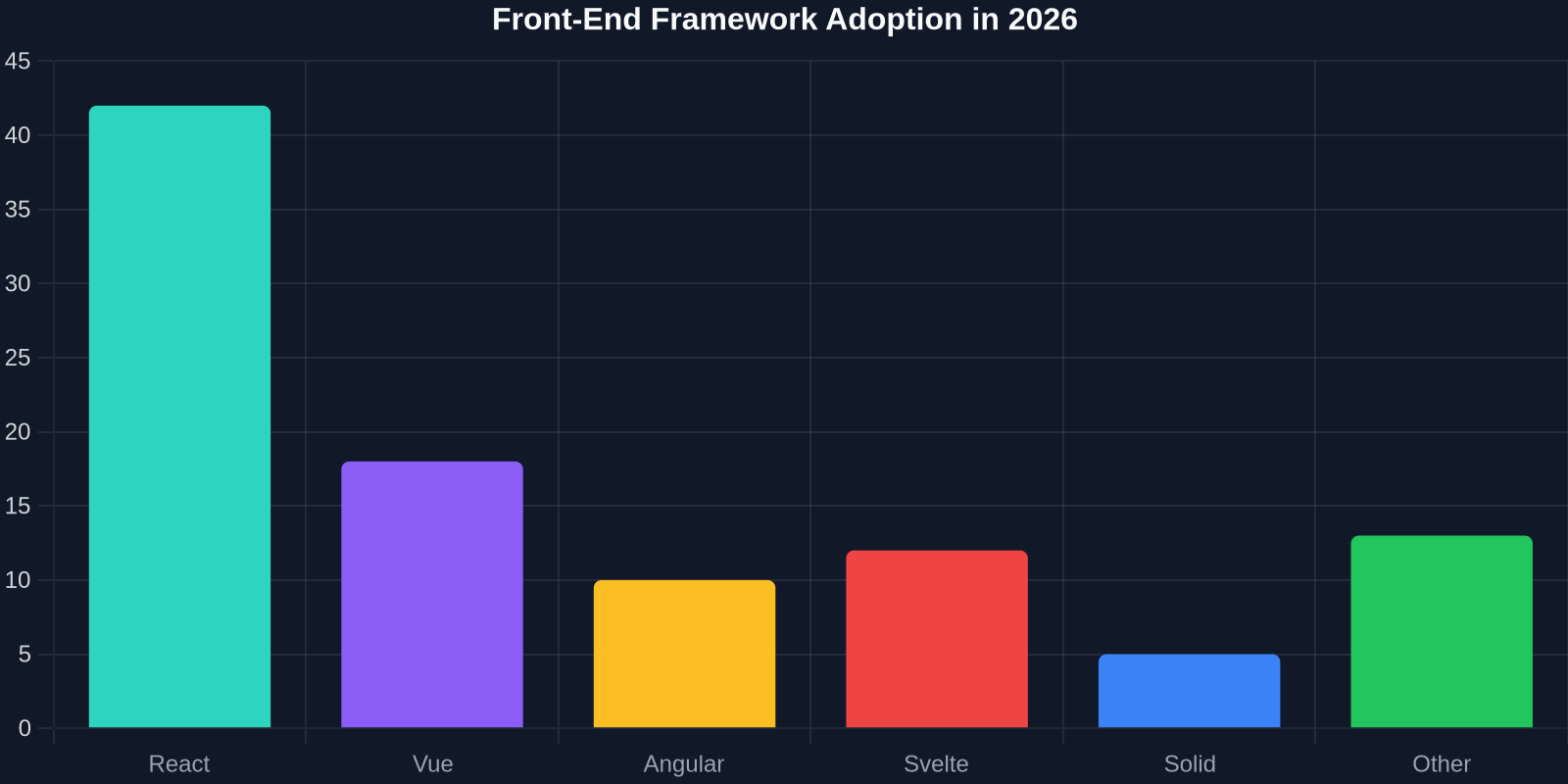

Frameworks are no longer the battlefield they once were. React has cemented its position as the dominant library, but the ecosystem is fragmenting in interesting ways. Svelte and Solid are capturing mindshare for their compilation-first approaches, offering smaller bundle sizes and simpler mental models. Meanwhile, Angular maintains a solid foothold in enterprise environments where conventions and structure are paramount.
“The biggest web design trends in 2025, simplicity, personalization, and immersive experiences, have become the engineering standards of 2026.”
The trends we see in web design directly influence front-end implementation. Minimalism now translates into leaner code, critical CSS inlining, and aggressive tree shaking. Personalization drives the need for dynamic, user-specific rendering with edge functions and A/B testing at scale. Immersive experiences push WebGL, WebAssembly, and advanced animation libraries into the mainstream.
AI-Assisted Development: From Copilot to Autonomous UI Generation
AI-powered tooling has moved from early adopter novelty to near-universal adoption. ChatGPT, GitHub Copilot, and specialized tools like v0 and DivMagic are reshaping how developers approach everyday tasks.
Front-end developers who embrace AI-assisted coding are reporting 30-50% faster time-to-deployment for UI tasks, according to industry surveys. The key is knowing when to rely on AI and when to apply deep expertise.
Generative UI tools can now translate design mockups into production-ready code, complete with responsive breakpoints and accessibility attributes. However, they are most effective when guided by developers who understand semantic HTML, CSS architecture, and component composition.
WebAssembly (Wasm) Goes Mainstream
WebAssembly continues its steady ascent, enabling near-native performance for browser-based applications. Use cases extend beyond gaming and image processing, 2026 sees Wasm powering complex data visualization dashboards, in-browser video editing, and even lightweight ML inference. The ability to share code between server and client without sacrificing performance is a game-changer for resource-intensive tools.
Micro-Frontends Mature
Once a controversial pattern, micro-frontends have proven their worth in large-scale applications where independent teams need to deploy autonomously. Framework-agnostic solutions like Module Federation (from Webpack) and single-spa have stabilized, and organizations are building internal platforms to standardize micro-frontend orchestration. This trend aligns with the broader move toward composable architectures.
The Observabilitiy Imperative in Front-End
The observability boom isn't limited to infrastructure. Front-end monitoring has become a board-level concern as organizations realize that slow, unresponsive interfaces directly cost millions in lost revenue. Core Web Vitals, especially Interaction to Next Paint (INP), are now integrated into CI/CD pipelines, and teams are automating regression detection for performance budgets.
Key metrics now tracked include:
- Largest Contentful Paint (LCP)
- First Input Delay (FID) / INP
- Cumlative Layout Shift (CLS)
- Custom user timing marks for critical business flows
The integration of RUM with back-end tracing creates end-to-end visibility, allowing teams to pinpoint whether a slowdown stems from the client, network, API, or database, and fix it faster.
The Tooling Landscape: From Hand-Coded to AI-Augmented