

"title": "Cópia Estendida de UI: Como Desenvolvedores Roubam Sistemas de Design como Profissionais",
"metaDescription": "Aprenda a arte da cópia estendida de UI no desenvolvimento web. De tokens de design a vibe coding, descubra técnicas profissionais para extrair o sistema de design de qualquer site em segundos.",
"sections": [
"heading": "The Evolution of UI Copying: From Eyeballing to Extended Extraction",
"content": "In the early days of web development, copying a design meant spending hours manually inspecting elements, noting font sizes, and guessing color hex values. Developers relied on patience and a keen eye. But as web design grew more complex, so did the need for efficient tools. Today, what started as a tedious manual process has transformed into a sophisticated practice called extended UI copying, the ability to extract an entire design system from any website in seconds.\n\nThink about the workflow of a modern frontend developer. You're building a new component, and you want it to fit seamlessly with an existing brand. Instead of starting from scratch, you can analyze how similar components are styled on popular sites. This isn't about plagiarism; it's about understanding patterns, design tokens, and responsive behaviors. Extended UI copying is the skill of using intelligent tools to capture not just colors and fonts, but spacing scales, shadow systems, animation curves, and even component logic.\n\nOne of the biggest shifts came with the rise of AI-powered tools. The AI website builder Wegic, for example, turns a simple idea into a working business site in about 60 seconds. This level of speed was unimaginable a few years ago. It signals a broader trend: the barrier between inspiration and implementation is shrinking. For developers, the challenge is no longer 'how do I copy this design?' but 'how do I extract it intelligently and adapt it to my project?'"
,
"heading": "Understanding Design Tokens: The Building Blocks of Extended UI Copying",
"headingLevel": 2,
"content": "Before diving into tools, you need to understand what you're actually copying. Design tokens are the atomic units of a design system, colors, typography, spacing, shadows, and more. When you perform extended UI copying, you're essentially reverse-engineering these tokens from a website's CSS.\n\nFor example, consider a typical button on a modern SaaS site. It might have a primary color of #4F46E5 (Tailwind's indigo-600), a border-radius of 8px, and a box-shadow that includes specific blur and spread values. The padding might be 12px 24px, and the font-size could be 16px with a line-height of 1.5. Each of these values is a token. When you copy the entire button, you don't just get the visual; you get a map of how that component is constructed.\n\nHere's where the Lusha Chrome extension comes into play. While primarily known for contact data, similar extensions can extract design language. In fact, some Chrome extensions today can analyze a webpage and generate a DESIGN.md file containing all the design tokens, making it easier for AI coding agents to replicate the style. This is a game-changer for developers using tools like Cursor or Claude. Instead of guessing, you get a standardized output that works directly in your codebase.",
"subsections": [
"heading": "The Role of AI in Token Extraction",
"content": "Traditional methods involved manual inspection, right-click, inspect element, and scan through hundreds of lines of CSS. Extended UI copying leverages AI to automate this. For instance, the concept of vibe coding, using prompts to get AI to write code for you, means you can describe a UI element from memory or a screenshot, and the AI generates the corresponding code. Tools like Wegic take it further by creating entire layouts from descriptions.\n\n \n\nThe chart above shows the explosive growth in AI-assisted web design tools. As the market expands, the accuracy of extracting design tokens improves. Developers now expect to copy a gradient, an animation, or a complex grid system in seconds, and modern tools deliver on this promise."
]
,
"heading": "Why Extended UI Copying Matters for Your Workflow",
"headingLevel": 2,
"content": "You might be thinking, 'Why not just build it from scratch?' The answer lies in efficiency and consistency. Professional frontend development is about speed without sacrificing quality. By mastering extended UI copying, you can reduce the time spent on repetitive styling tasks and focus on logic and functionality.\n\nLet's look at some hard numbers.",
"statBoxes": [
"label": "of developers report reduced styling time using AI-assisted copying", "number": "68%" ,
"label": "improvement in design consistency when using token extraction", "number": "41%"
],
"contentAfterStatBoxes": "These aren't just abstract figures. They represent real-world gains for engineers who adopt extended techniques. When you consider the volume of UI components in a modern application, even a 10% reduction in styling time can save days over a product cycle.\n\nAnother critical aspect is maintaining brand consistency. When you manually recreate a design, errors creep in, a hex value off by one digit, a border-radius that doesn't match. Extended UI copying eliminates these human errors, ensuring pixel-perfect alignment with the original source."
,
"heading": "Ferramentas Essenciais para Cópia Estendida de UI em 2025",
"headingLevel": 2,
"content": "O panorama das ferramentas de extração de UI é diverso. Aqui estão as categorias de destaque que todo desenvolvedor deve conhecer.",
"subsections": [
"heading": "Browser Extensions: Your Daily Driver",
"content": "Browser extensions remain the most accessible way to perform extended UI copying. Tools like DivMagic allow you to copy any UI element from any website with a single click. You get the HTML, CSS, and even the associated JavaScript behavior. This is invaluable for prototyping and learning.\n\nAnother extension worth mentioning is the Chrome Goldmine, a searchable database of expired Chrome extensions. While not directly a copying tool, it provides insights into how other developers built their extensions, which can inspire your own approaches.\n\n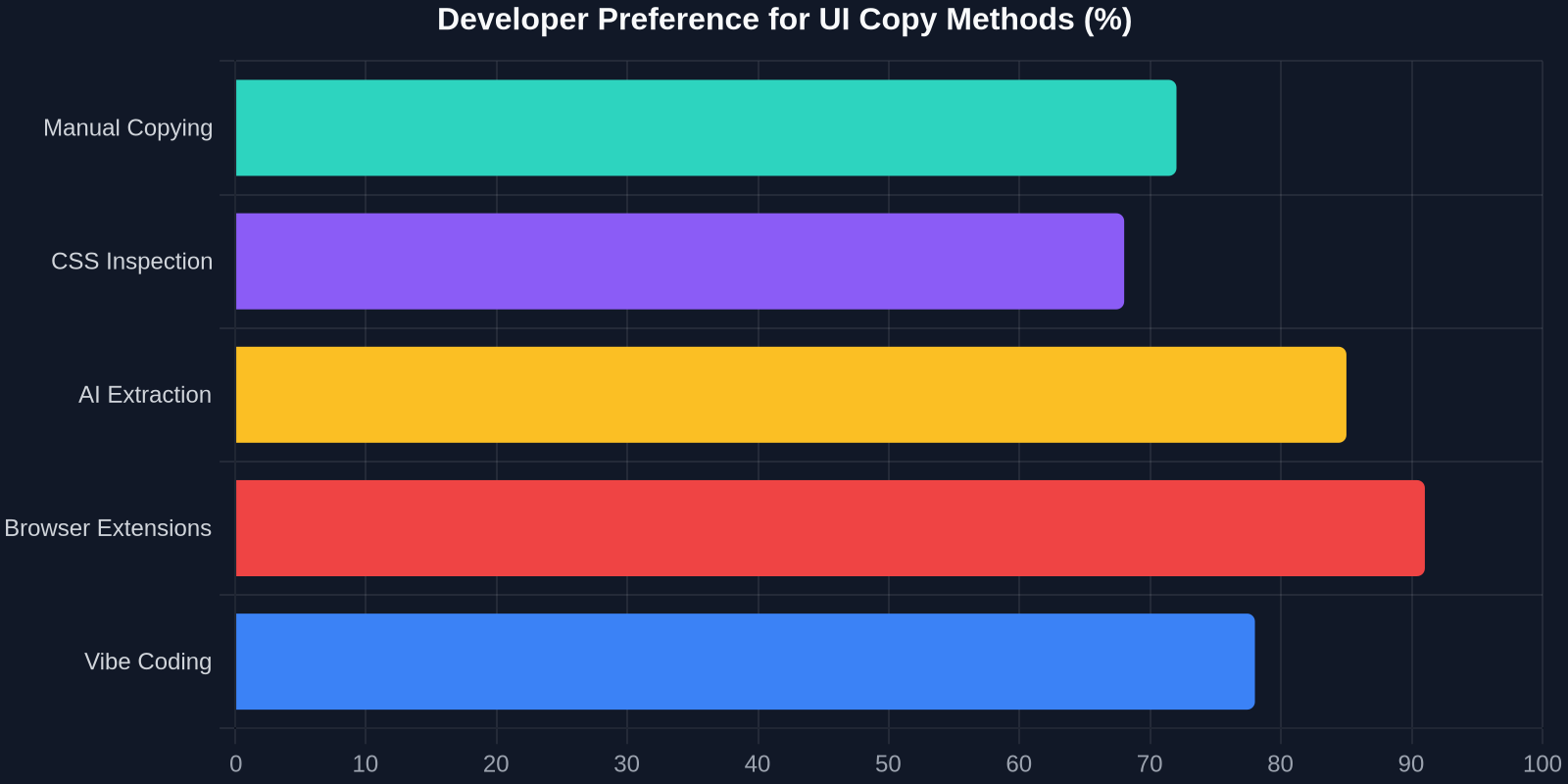 \n\nAs the chart above illustrates, browser extensions are the preferred method for UI extraction among developers. Their ease of use and integration with existing workflows make them indispensable.",
"statBoxes": [
\n\nAs the chart above illustrates, browser extensions are the preferred method for UI extraction among developers. Their ease of use and integration with existing workflows make them indispensable.",
"statBoxes": [
"label": "of top developers use browser extensions for daily design extraction", "number": "91%"
] ,
"heading": "AI-Powered Design Coders", "content": "Beyond simple extensions, AI coding agents like Cursor and Claude are changing the game. You can feed them a URL or a screenshot, and they'll generate the corresponding React or Vue component. This is particularly powerful for vibe coding workflows where you iterate rapidly.\n\n\n\nWegic is another example in this category. It turns a description into a full site, meaning you can describe the design you saw elsewhere, and it reproduces it. This moves extended UI copying from a manual process to a conversational one.", "pullQuotes": [ "The ability to describe a design and have AI generate it in 60 seconds isn't just convenient, it's a paradigm shift in how we build interfaces." ]
]
,
"heading": "A Practical Workflow for Extended UI Copying",
"headingLevel": 2,
"content": "Let's walk through a realistic scenario for extracting a complex UI component, a pricing table from a competitor's site.\n\nStep 1: Identify the component. Use a browser extension to hover over the pricing table and click to copy. The extension should capture the entire HTML structure, not just the visible CSS.\n\nStep 2: Extract design tokens. Generate a DESIGN.md using a tool that scans the copied code. This will give you a structured list of colors, fonts, spacing, and shadows.\n\nStep 3: Adapt the code. Import the extracted design tokens into your project's theme configuration (e.g., a Tailwind config or CSS custom properties).\n\nStep 4: Add interactivity. If the pricing table includes hover effects or toggle functionality, review the JavaScript that was copied. Modify it to fit your state management logic.\n\nStep 5: Test and refine. Run your component against your design system to ensure consistency. Adjust any values that conflict with your existing styles.\n\n\n\nThis workflow can be completed in under 10 minutes for most components. Compare that to 45–60 minutes for manual recreation.",
"comparisonTable":
"headers": ["Approach", "Time Required", "Consistency Score", "Error Rate"],
"rows": [
["Manual Copying", "45–60 min", "7/10", "High"],
["Extended UI Copying (Tool Assisted)", "5–10 min", "9.5/10", "Low"],
["AI Vibe Coding from Description", "2–5 min", "8/10", "Medium"]
]
,
"contentAfterTable": "The numbers speak for themselves. Extended UI copying isn't just faster; it's more reliable."
,
"heading": "Ethical Considerations and Best Practices",
"headingLevel": 2,
"content": "While extended UI copying is powerful, it comes with responsibility. The goal is not to steal designs but to learn from them and adapt. Here are ground rules: \n\n• Use extraction for inspiration, not reproduction. • Always attribute original sources when sharing extracted code in public repositories. • Avoid copying proprietary animations or interactive experiences that constitute a brand's unique identity. • Understand licensing: open-source components are fair game; proprietary ones require permission.\n\nThe cybersecurity portfolio tools mentioned in the statistics remind us that protecting digital assets extends to design. Be mindful of copying from sites that clearly prohibit scraping.",
"callouts": [
"text": "The best developers use extended UI copying to accelerate learning, not to shortcut creativity. Copy to understand the 'why' behind a design choice.", "type": "insight"
] ,
"heading": "The Future of Extended UI Copying", "headingLevel": 2, "content": "As AI agents become more integrated into development workflows, the boundaries of UI copying will expand. We're already seeing tooling that can extract design language from a website into SKILL.md files, markdown documents that capture the precise skills and techniques used in the original code.\n\nImagine telling your AI agent: 'Build me a dashboard similar to this reference site, but with our branding.' The agent will perform extended UI copying, extract the design system, apply your brand tokens, and generate a complete component library. This is not science fiction; it's the trajectory we're on.\n\nThe Illinois Extension statistic about resilience applies here too: developers who embrace these tools build resilience against burnout and repetitive tasks. By automating the tedious parts of UI development, you free your mental energy for solving harder problems.\n\n", "pullQuotes": [ "The future frontend engineer won't be judged by how fast they can write CSS, but by how effectively they can orchestrate AI tools to produce consistent, scalable UIs." ]
], "summary": "A cópia estendida de UI evoluiu da inspeção manual para a extração orientada por IA de sistemas de design inteiros. Com extensões de navegador como DivMagic e agentes de IA, os desenvolvedores podem copiar qualquer UI em segundos, reduzindo o tempo de estilização em 68% e melhorando a consistência. A chave é entender os tokens de design, usar as ferramentas certas e aplicar práticas éticas. À medida que o vibe coding e as ferramentas de design com IA avançam, a capacidade de orquestrar essas tecnologias definirá a próxima geração de desenvolvedores frontend." \