

Browser Extensions: The New Frontier of Supply Chain Attacks (And How Developers Can Fight Back)
In April 2026, the JavaScript ecosystem shuddered. A browser extension supply chain attack originating from a compromised popular utility extension had silently infected tens of thousands of developer machines. The attack vector wasn't a zero-day in Vercel or Next.js, it was a tiny "Allow All" permission that every developer had accepted hundreds of times. The discussion on the Aikido blog about this incident sent shockwaves through the developer community, with some calling it "the largest supply chain attack in history."
As frontend engineers, we often focus on runtime security, CSP headers, and sanitizing user inputs. But our own tooling, the very browser extensions we use to debug, design, and develop, has become a massive, largely unguarded attack surface. Statistics from IBM's 2025 data reveal that 42% of breaches now involve cloud environments, and a growing number trace back to compromised extensions infiltrating CI/CD pipelines through developer workstations.
To visualize the landscape, consider the primary vectors involved in browser extension supply chain attacks. The data from the Aikido report and industry analyses reveals a clear pattern.
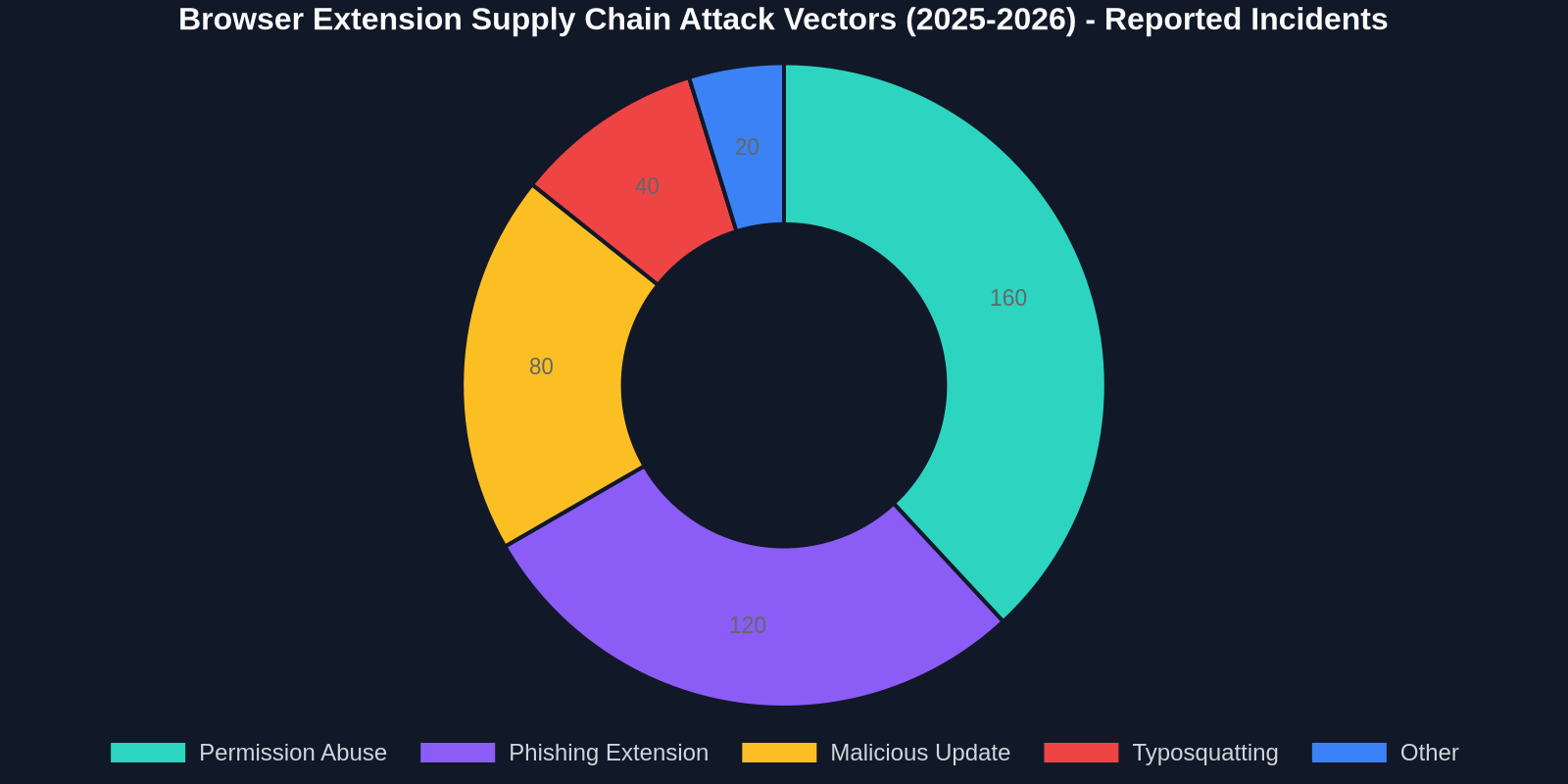
Permission abuse accounts for the largest share of incidents. Extensions that request broad permissions, "access to all website data," "manage your downloads," "communicate with cooperating native applications", create a simple path for data exfiltration. Phishing extensions, often mimicking popular tools like React Developer Tools or Vue Devtools, are the second most common vector, relying on developers who are habituated to installing new tools daily.
Why Frontend Developers Are the Prime Target
There's a reason supply chain attacks increasingly focus on frontend developers. We are the gatekeepers of the user interface, but we also hold the keys to the kingdom. Our environment variables contain API keys for services like Stripe, Auth0, or Firebase. Our local development servers mirror production databases. Our workspaces contain entire repositories. A single compromised extension can exfiltrate all of this.
Furthermore, many frontend developers work in fast-paced startups where security review is an afterthought. The pressure to ship features quickly means that a new extension to "boost productivity" is installed without a second glance. According to the Aikido report, the increasing complexity of supply chains, coupled with a lack of visibility into suppliers' security measures, has emerged as a leading cybersecurity risk. When you install an extension, you're trusting not just the developer, but every third-party library and API they've integrated.
This was not a sophisticated zero-day exploit. It was a simple, well-executed supply chain attack that exploited the gap between developer convenience and security. The extension received an update from its maintainer's account, which had been compromised via a phishing attack.
The Hidden Danger of Remote Code Execution (RCE) in Extensions
One of the most dangerous vulnerabilities is Remote Code Execution (RCE). Identified as CVE-2025-55182, this vulnerability allows malicious code to be executed remotely once an extension has been granted certain permissions. In the context of browser extensions, this can turn a developer's machine into a botnet node, exfiltrating data silently in the background.
For example, an extension with permissions to communicate with external websites can download and execute arbitrary JavaScript payloads. This effectively bypasses the Chrome Web Store's review process, as the malicious behavior is never present in the initially reviewed version. It's only triggered days or weeks later, when the extension's remote server begins serving malicious scripts.
Comparing Security Approaches: How Do Your Practices Stack Up?
To understand the risk, let's compare common approaches to browser extension security.
2. Implement Extension Isolation Policies
Consider using browser profiles dedicated to specific tasks. For example, have one profile for development work (with only essential, security-audited extensions) and another for personal browsing. This contains any potential breach. Tools like DivMagic allow developers to copy UI components without installing a permanent extension, reducing the attack surface even further.
3. Use Secret Scanning and Environment Variable Rotation
Services like GitGuardian or GitHub's secret scanning can help you detect leaked keys in your repositories. Coupled with regular rotation of all environment variables, this limits the damage from any single compromise. Automate this process in your CI/CD pipeline.
4. Prefer Extensions with Minimal Permissions
Opt for extensions that use the principle of least privilege. For UI development and component copying, tools like DivMagic operate with minimal host permissions, requesting access only to the active tab's content when you explicitly trigger the tool. This eliminates the risk of background data exfiltration.
5. Educate Your Team About Typosquatting and Phishing
Typosquatting extensions that mimic popular tools (e.g., "React Developer Tool" instead of "React Developer Tools") are common. Train your team to verify the publisher's identity, read reviews carefully, and check the extension's last update date. Legitimate tools often have tens of thousands of reviews and a clear website.
The Role of Tools Like DivMagic in Reducing Attack Surface
One of the most effective ways to mitigate the risk of extension-based supply chain attacks is to limit the number of extensions you use that require broad, always-on permissions. This is where purpose-built, permission-minimal tools shine.
DivMagic, for example, is a browser extension designed for a single, developer-essential task: copying UI components from any website. Instead of requesting blanket access to all websites, it activates only when you click the extension icon and only on the active tab. This time-based permission model means the extension has no background processing capability, it cannot silently exfiltrate data or receive malicious updates that run in the background.
In a world where even well-maintained extensions can be compromised via their maintainer's accounts, reducing the attack surface through design is critical. By choosing tools that adhere to the principle of least privilege, developers can maintain productivity without compromising security.
Building for the Future: Security as a Frontend Concern
The browser extension supply chain attack is not a one-time event. As the Aikido report warns, the increasing complexity of supply chains, coupled with a lack of visibility into suppliers' security measures, will only amplify these risks. For frontend developers, this means security can no longer be delegated solely to the backend or DevOps teams. It's a frontend concern, baked into our tooling choices.
Here are actionable takeaways to embed into your daily workflow:
- Regularly audit your extensions: Schedule a monthly review of all installed browser extensions. Remove those you don't use. Review permissions for those you keep.
- Prefer permissions-minimal tools: When searching for a tool to copy UI, use DivMagic instead of installing a full-featured, all-access extension. This reduces your attack surface significantly.
- Implement environment variable quarantine: Use separate, isolated environments for development and production keys. Never store production keys in a .env file on your main development machine.
- Monitor for unexpected network activity: Use browser-based network monitors or tools like Wireshark to detect unusual outbound traffic from your extensions.
- Stay informed: Follow security blogs like Aikido, The Hacker News, and BleepingComputer. Awareness is the first line of defense.
Conclusion: The Developer's Responsibility
The April 2026 attack was a wake-up call. It demonstrated that the browser, our primary development interface, has become a critical security boundary. As frontend developers, we must adopt a security-first mindset not just for the code we write, but for the tools we use. The frictionless "Allow All" is no longer acceptable.
By implementing the strategies outlined above, auditing permissions, isolating development environments, and choosing permission-minimal tools like DivMagic, you can significantly reduce your risk. The goal is not to eliminate friction (that's impossible), but to ensure that the friction exists where it matters: in the security review process, not in your ability to ship great UIs.
The frontend supply chain is only as strong as its weakest link. Let's make sure that link isn't a browser extension.